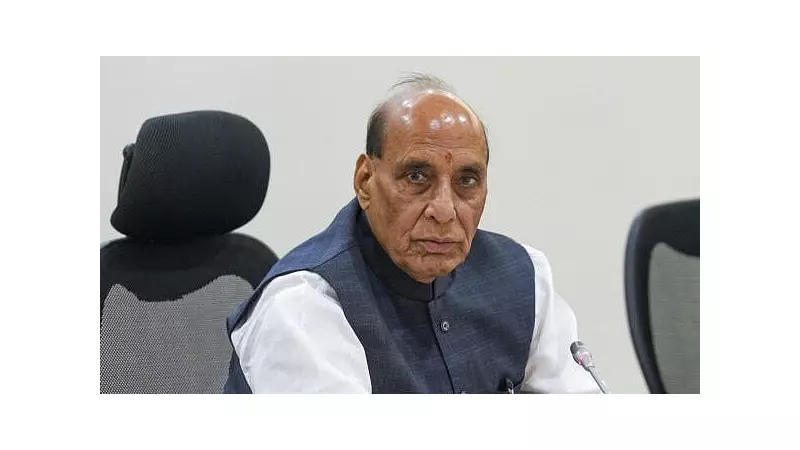
Defence Minister Rajnath Singh has made a significant historical claim, stating that India's first Prime Minister, Jawaharlal Nehru, intended to use public funds to rebuild the Babri Masjid in Ayodhya. Singh asserted that this plan was effectively thwarted by the country's first Home Minister, Sardar Vallabhbhai Patel.
Revelation at Sardar Patel's Unity March
Rajnath Singh made these remarks while addressing a public gathering in Sadhli village, located near Vadodara in Gujarat. The event was organized as part of a 'Unity March' commemorating the 150th birth anniversary of Sardar Vallabhbhai Patel. The Defence Minister used the platform to highlight Patel's principles and contrast them with Nehru's alleged approach.
Patel Hailed as a True Secular Leader
In his speech, Singh praised Sardar Patel as a genuine liberal and secular figure. He emphasized that Patel's brand of secularism was firm and never involved the practice of appeasement for any community. Singh credited Patel for preventing the proposed use of government treasury money for the reconstruction of the Babri mosque, a move he attributed to Nehru.

The Defence Minister's comments add a new dimension to the historical discourse surrounding the decades-long Ayodhya dispute. By framing Patel as a decisive figure who stopped what he implied was an inappropriate use of public funds, Singh aimed to elevate Patel's legacy as a pragmatic and fair-minded leader.
Context and Political Significance
The event took place on December 2, 2025, and the news was reported by the Press Trust of India (PTI). The choice of location—Gujarat, the home state of both Sardar Patel and Prime Minister Narendra Modi—and the occasion of Patel's anniversary gave the statement considerable symbolic weight. The 'Unity March' itself is a event designed to celebrate Patel's role in integrating princely states into the Indian union.
This revelation is likely to reignite debates about the historical roles of two of India's most prominent founding fathers. It directly touches upon the sensitive and politically charged issue of the Babri Masjid, which was demolished in 1992 and where a grand Ram temple now stands following a Supreme Court verdict in 2019.
Rajnath Singh's narrative positions Sardar Patel as a stalwart who upheld a principle-based governance model, contrasting it with a perceived policy of appeasement. The statement serves not only as a historical assertion but also as a contemporary political commentary on governance and secularism in India.