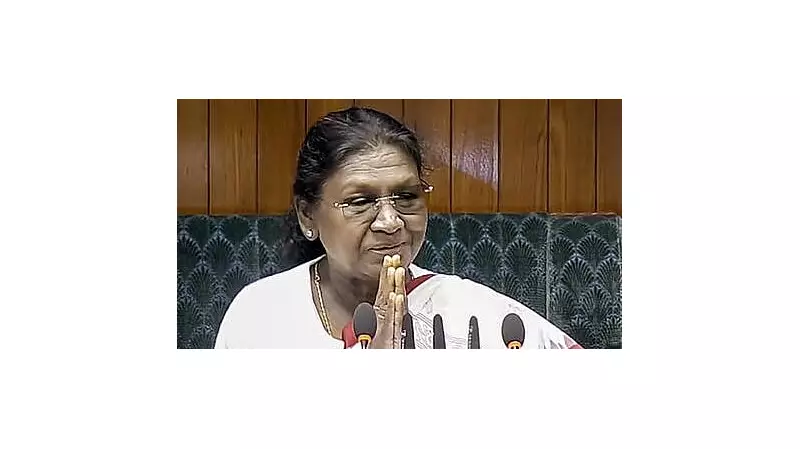
In a significant address to the Parliament, President Droupadi Murmu invoked historical references and cultural pride, sparking discussions across the nation. Her speech, delivered on January 28, 2026, touched upon the enduring impact of colonial policies while celebrating India's deep-rooted heritage.
Murmu's Critique of Colonial Conspiracies
President Murmu did not shy away from addressing the contentious legacy of British colonialism. She specifically cited Thomas Macaulay, the 19th-century British historian and politician, whose educational policies are often criticized for attempting to create a class of Indians loyal to the British Empire. Murmu referred to these as 'conspiracies,' highlighting how such colonial strategies aimed to undermine indigenous cultures and systems.
This reference underscores a broader narrative in contemporary Indian politics, where there is a renewed focus on decolonizing education and cultural practices. Murmu's remarks align with ongoing efforts to reevaluate historical narratives and promote indigenous knowledge systems.

Praising Somnath's Enduring Spirit
In her speech, President Murmu also hailed the enduring spirit of Somnath, a reference to the iconic Somnath Temple in Gujarat. This temple, destroyed and rebuilt multiple times throughout history, symbolizes resilience and cultural continuity. By highlighting Somnath, Murmu emphasized the importance of preserving and drawing strength from India's historical monuments and spiritual sites.
She noted that such landmarks are not just architectural marvels but also embodiments of the nation's collective memory and identity. This praise resonates with current government initiatives aimed at restoring and promoting heritage sites as part of India's cultural diplomacy and tourism strategy.
Transforming Heritage into National Strength
President Murmu articulated a vision for leveraging India's cultural wealth as a cornerstone of national development. She stated, 'From the cultural perspective, India is among the richest nations in the world. My government is working to transform this heritage into a source of strength for the country.'
This statement reflects a strategic approach to cultural policy, where heritage is viewed not merely as a relic of the past but as a dynamic asset. Key aspects of this transformation include:
- Educational Reforms: Integrating traditional knowledge and arts into modern curricula to foster pride and innovation.
- Economic Initiatives: Promoting cultural tourism, handicrafts, and creative industries to boost livelihoods and GDP.
- Diplomatic Outreach: Using cultural exchanges to enhance India's soft power on the global stage.
Murmu's emphasis on heritage aligns with broader governmental schemes, such as the 'Make in India' campaign and efforts to revive ancient practices like yoga and Ayurveda. By framing culture as a source of strength, she positions it as integral to India's growth story in the 21st century.
Context and Implications
The speech comes at a time when India is navigating complex domestic and international landscapes. Murmu's references to Macaulay and Somnath serve as symbolic gestures that reinforce nationalistic sentiments while addressing historical injustices. This approach may resonate with voters and stakeholders who prioritize cultural revival and historical rectification.
Moreover, her remarks could influence policy directions, encouraging more investments in cultural infrastructure and research. As India continues to assert its identity on the world stage, such speeches play a crucial role in shaping public discourse and governmental priorities.
In summary, President Droupadi Murmu's Parliament address was a multifaceted discourse that blended historical critique with cultural celebration. By citing Macaulay's conspiracies and hailing Somnath's spirit, she underscored the importance of learning from the past while building a future rooted in India's rich heritage. Her vision of transforming this heritage into national strength highlights a forward-looking agenda that could have lasting impacts on education, economy, and diplomacy.