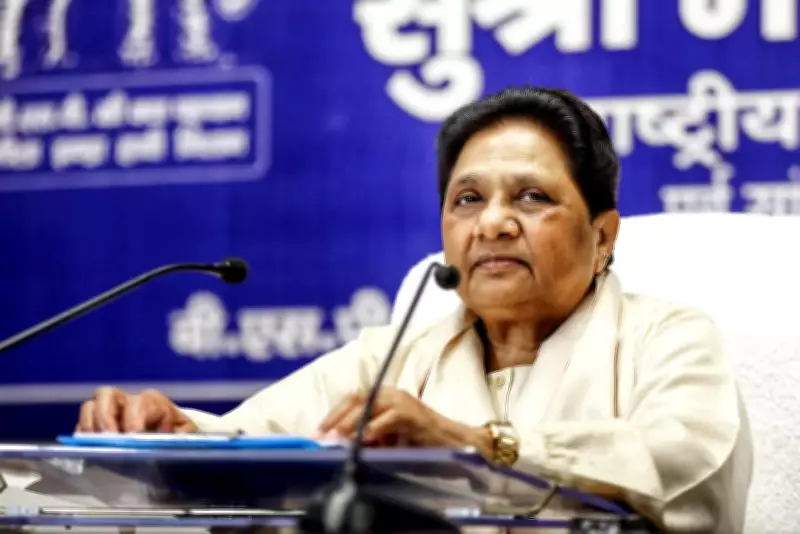
Mayawati Advocates for Separate Quota for SC/ST/OBC Women in Reservation Bill
Bahujan Samaj Party (BSP) president Mayawati on Wednesday called for a separate quota for women from Scheduled Castes (SC), Scheduled Tribes (ST), and Other Backward Classes (OBC) within the proposed 33% reservation for women in the Lok Sabha and state assemblies. She emphasized that the absence of such a provision would "negate" the fundamental objective of the measure, which aims to enhance women's representation in politics.
Historic Parallel Drawn to Mandal Commission
Mayawati stated that it would have been appropriate to allocate a distinct quota for women from these marginalized categories under the provision, "which is not a part of it right now." She drew a parallel to the historic 27% reservation in education and government jobs for OBCs, as recommended by the Mandal Commission. "Had it been so, it would have been as historic as giving 27% reservation in education and govt jobs to OBCs, as per the recommendations of the Mandal Commission, and after a long struggle by BSP," she remarked, highlighting her party's longstanding advocacy for social justice.
Welcome Yet Delayed Move
Despite her critique, Mayawati welcomed the central government's initiative to advance the process of granting 33% reservation to women in Parliament and state assemblies, albeit noting it was "delayed." Her reaction came a day ahead of Parliament's special session scheduled for Thursday, which is expected to pass the Women's Reservation Bill. She urged political parties to rise above partisan interests and support the move, asserting, "Getting something, even if little, is always better than getting nothing. There should be no roadblocks created."

Criticism of Congress and Historical Context
On the issue of a separate quota for SC, ST, and OBC women, Mayawati criticized the Congress party for demanding it now. "Why are they getting these thoughts now? When they were in govt, they completely overlooked this important issue, given their caste-driven hatred," she said. She referenced historical context, noting that when Dr. B.R. Ambedkar sought to introduce the Hindu Code Bill to grant women strong legal rights in inheritance, marriage, and property, the Congress government at the Centre did not agree, leading to Ambedkar's resignation as India's first law minister. "Nevertheless, Babasaheb should be thanked for giving women the right to vote same as men," she added, acknowledging his contributions.
Broader Perspective on Women Empowerment
Mayawati emphasized that reservation for women should be viewed through the lens of "safety, respect and growth for women" rather than political interests. She lamented that women empowerment has often been reduced to lip service, with a lack of honest intent and effective policies resulting in increased exploitation. "So far, women empowerment has merely been paid lip service, as honest intent and policy for the cause was missing. The result was an increase in exploitation of women," she stated, calling for substantive action.
BSP's Stance and Party Activities
The former Uttar Pradesh chief minister reiterated that BSP has consistently demanded 50% reservation for women from all sections, proportional to their population, but no political party was willing to adopt this idea due to their own compulsions and interests. Meanwhile, she expressed gratitude to party functionaries and supporters for gathering at the Ambedkar Memorial in Lucknow to pay tributes on his birth anniversary on April 14. "It was for the convenience of these people that I paid tributes to Babasaheb at my residence, along with senior office-bearers and workers of the party," Mayawati said, highlighting her engagement with party activities.
As the special parliamentary session approaches, Mayawati's demands underscore the ongoing debates around inclusivity and social justice in India's legislative reforms, with a focus on ensuring that women's reservation benefits all sections of society equitably.