Manu Joseph's Perspective: The Case for Not Voting in Indian Elections
In a thought-provoking commentary, journalist and novelist Manu Joseph challenges the prevailing notion that voting is an unquestionable civic duty in India. He presents a compelling argument that choosing not to participate in elections shouldn't automatically be viewed as apathy, arrogance, or moral failure.
The Changing Perception of Voting Abstention
Until two decades ago, not voting was considered relatively unremarkable among significant sections of the urban middle class. Joseph notes that as the leaders of India's freedom movement receded from public life, politics transformed from an idealistic reform movement into a domain dominated by practical considerations. "Indian politics appeared to be the revenge of the poor," he observes, leading many from privileged backgrounds to disengage from the electoral process.
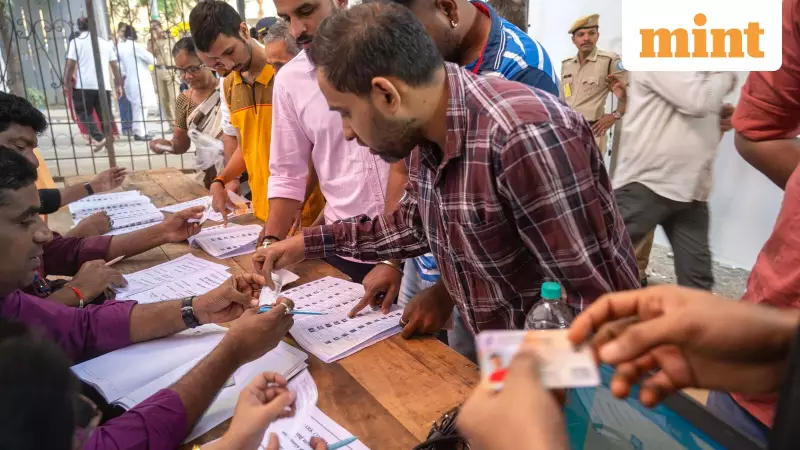
This has changed dramatically in recent years. Voting has become so popular that even municipal elections in cities like Mumbai now generate substantial middle-class discussion—a phenomenon that would have been unthinkable just a decade ago. Joseph recounts an anecdote from the Jaipur Literature Festival where a speaker admitted voting primarily to display the ink stain on her finger as proof of being an engaged modern Indian.

Why Joseph Chooses Not to Vote
The author makes his position clear: he doesn't vote and never has. His reasoning stems from a fundamental disconnect between what he desires from society and what the electoral process can realistically deliver. "I don't vote because there is nothing I want that I can get in this country through my franchise," he states bluntly.
Joseph expands this beyond conventional political demands to encompass broader lifestyle preferences. He laments the inability to find food options in public spaces that align with his dietary preferences, describing how he often carries unsalted peanuts to avoid unhealthy offerings. Similarly, he expresses frustration with the "tyranny of the majority" that dictates everything from restaurant music to entertainment choices.
The Limitations of Electoral Politics
Joseph questions why he should participate in a system that "asks people to stand in a queue to legitimize ways to deny me my way of life." He points to what he perceives as the Indian electorate's preoccupation with "useless issues" and questions the practical value of his single vote in a system where majority preferences dominate.
His desires are surprisingly modest: functional roads with meaningful designs, clean cities with proper sidewalks, government schools with basic furniture and hygienic conditions, public transport that doesn't signal poverty, and hospitals where treatment isn't contingent on financial status. These aren't demands for European-level quality of life, he clarifies, but merely expectations that India should meet minimum standards comparable to other middle-income nations in East Asia.
Questioning the Moral Imperative of Voting
Joseph challenges the moral high ground often claimed by voting advocates. He reminds readers that B.R. Ambedkar, despite his monumental contribution to India's Constitution and popularity among Scheduled Castes, never won a Lok Sabha election and had to enter Parliament through the Rajya Sabha. "Was he punished, possibly, for saying that all Indians were equal?" Joseph asks provocatively.
He further notes that contemporary global turmoil often stems from popularly elected leaders rather than unelected autocrats, suggesting that democracy accurately reflects human nature—including its flaws. Technology has enabled what many desired: a "true" democracy that mirrors societal preferences with remarkable accuracy.
The Paradox of Mainstream Acceptance
Joseph finds it curious that while the middle class readily accepts his disinterest in mainstream Bollywood entertainment, they express surprise at his refusal to participate in what he calls "the mother of all that's mainstream in India"—the electoral process. This disconnect highlights what he sees as an unexamined assumption about voting's inherent virtue.

The commentary ultimately suggests that abstention from voting can be a rational, considered position rather than a moral failing. In a democracy where individual preferences often get subsumed by majority will, Joseph argues that choosing not to legitimize a system that doesn't serve one's interests represents a coherent philosophical stance worthy of consideration rather than condemnation.