

After decades of conflict and significant investment, Odisha's southernmost Malkangiri district has achieved a landmark status as "Naxal-free." This transformation follows the surrender of Sukhram Markam, a key Maoist commander, marking a pivotal moment in the region's long battle against Left-wing extremism.
The Final Blow: Surrender of a Maoist Commander
Sukhram Markam, also known as Suresh or Yogesh, surrendered before the Malkangiri district police on Wednesday. Originally from Govindpal village in Chhattisgarh's Sukma district, the 32-year-old was the commander of the Maoists' Kangerghati area committee. During his 16-year tenure, he was involved in numerous violent incidents, including exchanges of fire, IED blasts, abductions, and killings of civilians. Carrying a reward of Rs 21 lakh, Sukhram will now receive all benefits under the state government's rehabilitation policy, as confirmed by Malkangiri SP Vinodh Patil H.
A History of Violence and Isolation
Malkangiri district, bordering Andhra Pradesh and Chhattisgarh, has been a Maoist hotbed for over five decades. The Swabhiman Anchal area, once cut off due to a 65-km water channel from the Balimela reservoir project in the early 1960s, served as an ideal hideout for Maoists. This isolation led to tragic events, such as the 2008 ambush that killed 39 security personnel near the Balimela reservoir.

In February 2011, the district gained national attention when Maoists abducted then District Collector R Vineel Krishna and a junior engineer during an inspection in the cut-off areas, holding them hostage for eight days. Their release came only after bail was granted to top Maoist leader Ganti Prasadam. A year later, four BSF personnel, including a commandant, were killed in a landmine blast. The persistent Maoist threat even forced the State Election Commission to postpone panchayat polls in 18 gram panchayats and two zilla parishad zones in the Chitrakonda block.
Infrastructure as a Game-Changer: The Gurupriya Bridge
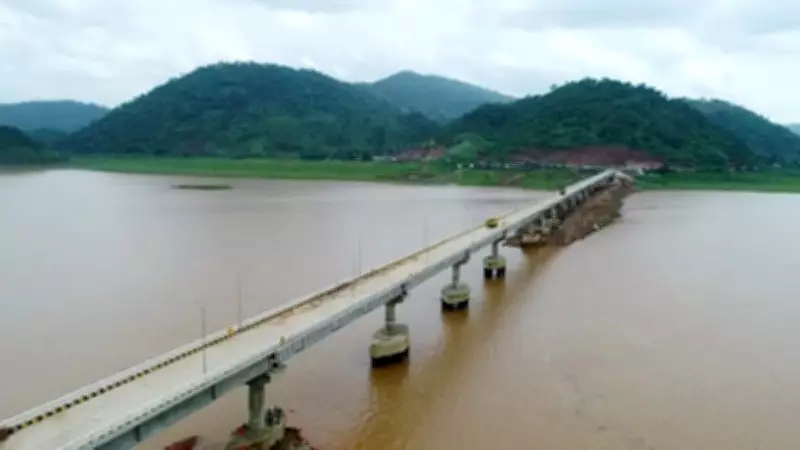
The turning point in curbing Maoist activities came with the completion of the 910-metre Gurupriya bridge in July 2018. This structure, connecting nearly 170 villages in the cut-off area, took over four decades and an investment of Rs 172 crore to build, starting in the mid-1980s with an initial estimate of Rs 8 crore. Construction faced delays due to Maoist resistance, prompting the government to deploy BSF personnel in the area in 2015.
Once operational, the bridge facilitated the acceleration of all-weather road construction in villages housing over 30,000 people, effectively ending Maoist dominance. The BSF established multiple company operating bases (COBs)—heavily-armed outposts—in Swabhiman Anchal to combat remaining threats. Under the Socio-Economic Transformation and Upliftment (SETU) initiative, massive infrastructure works, including roads, bridges, and electrification, were undertaken, creating livelihood opportunities and further weakening Maoist influence.
Current Progress and National Context
According to Malkangiri District Collector Somesh Kumar Upadhyay, almost all major habitations in Swabhiman Anchal are now connected with all-weather roads. During the 2024 polls, the region saw a record 30 polling booths, indicating improved accessibility and security. Nationally, the number of Left-wing extremism (LWE) districts has reduced to eight, with only Kandhamal remaining in Odisha, as per MHA sources.
This journey from a Maoist stronghold to a Naxal-free zone highlights the combined efforts of infrastructure development, security measures, and rehabilitation policies. The surrender of Sukhram Markam symbolizes a final surrender to peace, offering hope for sustained stability in Malkangiri.






