

Maharashtra Civic Polls Expose Strategic Voting Pattern
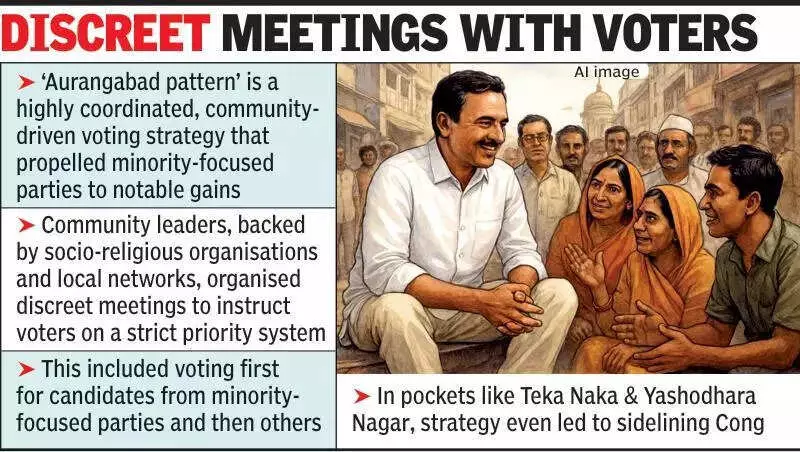
The recent civic elections across Maharashtra revealed a significant strategic oversight by established political parties and security agencies. Voters in Nagpur, Amravati, and Akola implemented a highly coordinated community-driven approach known as the 'Aurangabad pattern.' This strategy delivered notable electoral gains for minority-focused parties, stunning political observers when results emerged.
The Origins of the Aurangabad Pattern
This voting pattern first gained prominence in Chhatrapati Sambhajinagar, formerly called Aurangabad. It involves intensive pre-poll mobilization within minority-dominated areas. During previous assembly elections, this approach brought considerable success to minority-driven political parties.
"Security agencies collected, collated and analyzed this voting pattern previously," said an official from the state intelligence apparatus. "But the template appears to have been replicated in Nagpur, Amravati, and Akola too."

Electoral Impact Across Cities
The strategy produced tangible results in the just-concluded Nagpur Municipal Corporation polls. Asaduddin Owaisi's All India Majlis-e-Ittehadul Muslimeen made its Nagpur debut with six seats. The party performed strongly in specific wards, achieving complete sweeps in minority-heavy wards three and six.
In Amravati, AIMIM secured twelve seats, while in Akola, the party won three seats. The Indian Union Muslim League achieved an unprecedented four seats in Nagpur. Even Chandrapur saw AIMIM capture one seat.
Community Coordination and Voting Instructions
Community leaders, supported by socio-religious organizations and local networks, organized discreet meetings before elections. They instructed voters on a strict priority system for casting ballots.
"Voters received clear directions to support candidates from minority-focused parties first," explained an official familiar with the strategy. "Only when no minority leader or candidate contested should support shift to Congress or other anti-BJP parties."
This approach aimed to ensure maximum representation for minority interests while strategically leveraging political alliances. In areas like Teka Naka and Yashodhara Nagar, the strategy even sidelined Congress, traditionally viewed as a secular ally.
Political Parties Caught Unprepared
Despite clear precedents showing minority parties' steady rise in Marathwada region, major political formations underestimated this mobilization. The Bharatiya Janata Party, various Shiv Sena factions, and Congress all failed to anticipate the coordinated voting pattern.
BJP strategists reportedly focused on development narratives and anti-incumbency against rivals while overlooking ground-level consolidation in minority wards. Congress failed to recognize it would become a secondary choice for many minority voters.
"Where no minority party fielded candidates, Congress benefited by picking up thirty-four seats," noted a poll expert. "Congress would have crossed the fifty-seat mark if minorities had voted en bloc for the party."
Post-Riot Political Dynamics
Police actions following the March 17, 2025, communal riot in Nagpur created particular dynamics. Security agency sources stated the 'Aurangabad pattern' blindsided key parties on election day.
"Even the wife of the so-called mastermind of the Nagpur riots won a seat, despite having no political background," revealed an intelligence official. "Her community voted her to power as a mark of solidarity."
Regional Replication of the Model
Similar dynamics played out in Akola, where minority voters rallied around aligned candidates. This contributed to fragmented opposition gains amid BJP's traditional dominance in the Vidarbha region.
Sources indicate the trend mirrored the successful model from Chhatrapati Sambhajinagar. There, AIMIM dramatically increased its tally to thirty-three seats in the 115-member civic body, building on earlier assembly-level experiments.

A Strategic Shift Bypassing Traditional Surveillance
Insiders describe this development as a "strategic shift" that effectively bypassed traditional surveillance radars. The community-driven approach represents a new dimension in Maharashtra's electoral politics, with implications for future elections across the state.
The coordinated voting pattern demonstrates how localized community networks can significantly influence electoral outcomes, even when established political parties and security agencies remain unaware of their full impact until results are declared.





