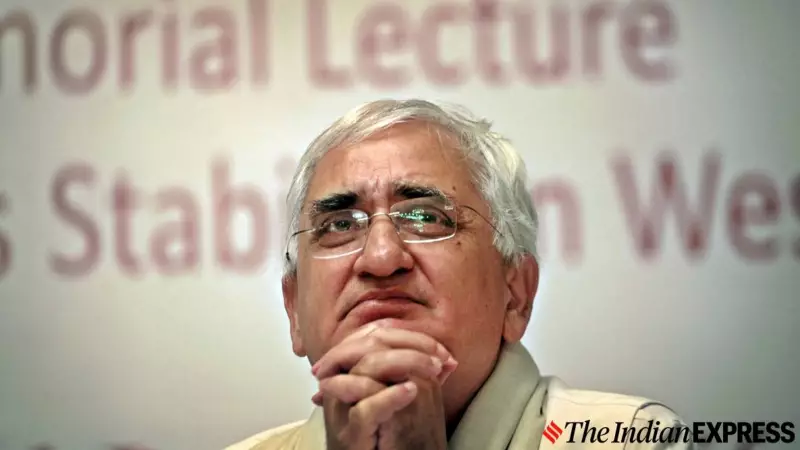
In a notable political remark, former External Affairs Minister and senior Congress leader Salman Khurshid offered a pointed, albeit indirect, rebuttal to a famous statement made by current EAM Dr. S Jaishankar. The exchange of perspectives highlights ongoing debates on India's foreign policy outlook.
Khurshid's Counter to Jaishankar's EU Maxim
The episode unfolded during the launch of Khurshid's book, 'India's Tryst with the World', in New Delhi on Thursday, January 8, 2026. Addressing the audience, Khurshid referenced the diplomatic tensions between the United States and the European Union concerning Greenland.
In this context, he suggested that Europe's problems have indeed become the world's problems. This observation was widely seen as a response to Dr. Jaishankar's 2022 comment where he stated, "Europe (thinks their) problems are the world’s problems, but the world’s problems are not Europe’s problems."

When journalists pressed Khurshid on how he would have handled the recent issue of US tariffs, the former minister diplomatically declined to speculate. "I am happy I didn't have to deal with it," he remarked, sidestepping direct commentary on the current government's handling of the matter.
Minister Chouhan's Praise and US Exit from International IDEA
In a separate development from the capital, Union Minister for Agriculture and Rural Development, Shivraj Singh Chouhan, hosted a New Year luncheon at his residence on the same day. The event was for senior officials from both his ministries.
The guests enjoyed a special vegetarian winter meal. Chouhan singled out Rural Development Secretary Shailesh Kumar Singh and his team for exceptional praise. He commended their crucial role in steering the passage of the VB-G RAM G Bill, 2025 through Parliament and urged other officials to emulate their dedication.
In international organizational news, the United States, on Wednesday, January 7, announced its withdrawal from 66 international bodies. One of these was the Stockholm-based International Institute for Democracy and Electoral Assistance (International IDEA).
This move comes at a significant juncture, as the organization recently appointed India, represented by Chief Election Commissioner Gyanesh Kumar, as its chair for 2026. Despite the withdrawal, sources indicated that as of Thursday, the US was still expected to participate in a three-day conference for International IDEA member states, which the Election Commission of India is set to host later this month.
Implications and Observations
Khurshid's comments underscore the nuanced and often divergent viewpoints within India's foreign policy discourse. While the current administration emphasizes strategic autonomy and a clear-eyed assessment of global partnerships, voices from the opposition reflect alternative interpretations of global interdependence.
Concurrently, the US withdrawal from International IDEA, even as India assumes a leadership role, presents a complex diplomatic scenario. It tests India's capacity to navigate and lead multilateral forums amidst the shifting priorities of major powers. The upcoming conference will be a key early test of this dynamic.
These snippets from the capital's political corridors, from domestic policy appreciation to global diplomatic maneuvering, paint a picture of a nation actively engaging with both internal governance challenges and its evolving role on the world stage.