

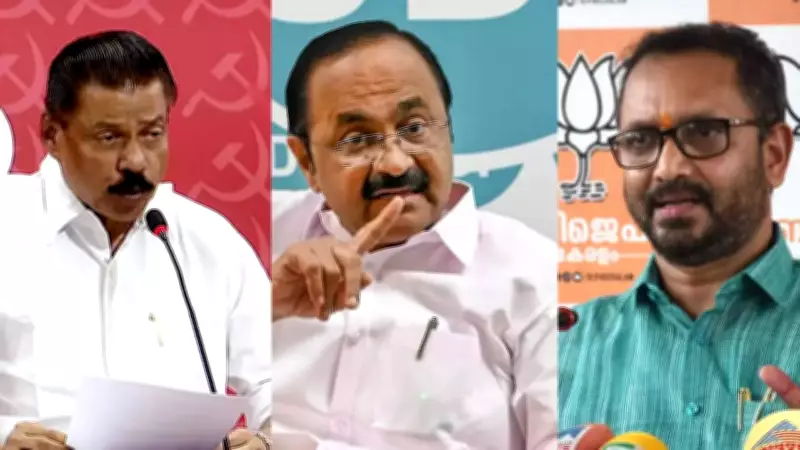
Kerala Election Storm: Jamaat-e-Islami Sparks Political War Between CPM, Congress, BJP
As Kerala heads toward another high-stakes assembly election, a controversial name has returned to the center of a new political storm. Jamaat-e-Islami, long part of the state's complex web of alliances and rivalries, is now the trigger for an escalating war of words between the CPM, the Congress, and the BJP.
What began as a debate over electoral support has quickly transformed into a larger fight over secularism, minority politics, and ideological credibility in one of India's most politically active states.
The Controversial Remarks That Ignited the Fire
The latest round of exchanges was triggered after Congress leader and Leader of the Opposition VD Satheesan indicated that the United Democratic Front (UDF) would accept support from Jamaat-e-Islami. He asserted that the organization had clarified it does not advocate for a religion-based nation in India.

That remark drew immediate criticism from both the CPM and the BJP, who accused the Congress of legitimizing a group they describe as communal and extremist in nature.
BJP's Strong Condemnation
Senior BJP leader K Surendran launched a scathing attack on the Congress, accusing the party of developing closeness with Jamaat-e-Islami and alleging that the party was "whitewashing" communal forces. He went further, making the dramatic claim that "sharia" would be implemented in Kerala if the Congress and the UDF came to power.
"The Congress has now adopted a blatant communal stand by whitewashing terrorist groups like Jamaat-e-Islami," Surendran declared, raising the political temperature significantly.
CPM's Sharp Criticism
The CPM, too, sharpened its attack on the Congress position. State secretary M V Govindan alleged that the Congress had adopted a position portraying Jamaat-e-Islami as a non-communal organization and accused it of attempting to give the outfit a "good certificate" despite its controversial history and statements.
Congress Fights Back With Historical Accusations
Satheesan rejected the allegations and accused the CPM of blatant hypocrisy. He alleged that the Marxist party had itself benefited from Jamaat-e-Islami support in the past, particularly during crucial elections.
"CPM is hypocritical. Until the parliamentary elections, they appeased minorities. Later, they appeased majority communities. Currently, there is confusion overall. They are in a state where they do not know what they are saying or doing. They are pretending to forget what they said in the past," Satheesan said during the UDF's Puthu Yuga Yatra in Kasaragod.
He further claimed, "For 42 years, Jamaat-e-Islami was aligned with the CPM. Many times, individuals like Govindan and Pinarayi Vijayan were elected with the support of Jamaat-e-Islami. Clips of Pinarayi Vijayan's speech justifying Jamaat-e-Islami and Deshabhimani's editorial can be sent to Govindan. If his forgetfulness is deliberate, then nothing can be done."
Satheesan also argued that the opposition was unfairly being targeted for engaging with community organizations. "We do not interfere in the internal matters of any community organizations. Our wish is for everyone to walk together. It is not the opposition leader's job to comment on any of this," he stated firmly.
Understanding Jamaat-e-Islami in Kerala's Context
In Kerala, references to Jamaat-e-Islami typically point to Jamaat-e-Islami Hind, a socio-religious organization with an active presence in the state through educational institutions, social initiatives, and community networks. Its political platform is the Welfare Party of India, which has contested elections and participated in local alliances.
The organization is not a dominant electoral force in Kerala but commands influence in certain regions, particularly in parts of northern districts. In a closely contested political landscape where margins can matter significantly, even limited organizational backing can acquire substantial importance.
Recent Controversial Statements
Jamaat-e-Islami has been in controversy several times for its ultra-conservative views. Only last month, its leader Shaikh Muhammed Karakunnu said that no true believer who loves Prophet Muhammad can reject an Islamic Republic.

In a Facebook post titled 'Would true believers reject Islamic Republic?' posted on January 17, Karakunnu said the Prophet was the founder of the Islamic Republic, with its headquarters in Medina, established without shedding even a single drop of blood.
The remarks came amid the CPM's attack on Jamaat-e-Islami, accusing the organization of subscribing to the ideology of establishing a theocratic nation. CPM leaders were quick to cite Karakunnu's remarks as vindication of their stand against the organization.
Kerala's Triangular Political Contest
Kerala's politics has traditionally been bipolar, with power alternating between the CPM-led Left Democratic Front (LDF) and the Congress-led UDF. The BJP, despite a growing vote share, has struggled to translate support into seats. In this context, debates over minority outreach and ideological positioning carry both symbolic and electoral weight.
For the CPM, attacking the Congress over Jamaat-e-Islami allows it to question the UDF's secular credentials while attempting to consolidate its own base among both minority and majority voters. For the BJP, the issue provides an opportunity to frame the Congress and the Left as engaging in minority appeasement, a narrative it has consistently deployed in Kerala.
The Congress, meanwhile, appears to be balancing objectives of reassuring minority voters that it remains open to their support, while countering charges that it is endorsing communal politics.
The Broader Political Calculus
Kerala has a significant Muslim population, and minority consolidation can influence outcomes in several constituencies. Historically, the Indian Union Muslim League has been the primary Muslim political force within the UDF. However, the presence of organizations like Jamaat-e-Islami adds complex layers to the competitive dynamic.
The CPM has previously worked with various community organizations, and its leaders have often defended engagement as part of Kerala's plural political culture. The Congress now argues that similar engagement cannot be selectively labeled as communal when practiced by different parties.
National Dimensions and Campaign Strategies
The BJP's intervention introduces a national dimension, especially as it seeks to expand its footprint in a state where it has yet to break through decisively. By raising the specter of "sharia" and accusing the Congress of legitimizing extremist forces, it seeks to polarize the debate and position itself as the defender of secular governance.
The controversy has also intersected with rival mass contact programs. While the UDF is conducting its Puthu Yuga Yatra to present what it describes as a vision for Kerala's future, the LDF is running the Vikasana Munnetta Jatha to highlight development initiatives under Chief Minister Pinarayi Vijayan.
Each side has used the Jamaat-e-Islami debate to undercut the other's campaign narrative. Satheesan has suggested that the CPM's criticism stems from discomfort over the UDF's electoral confidence, while CPM leaders argue that the Congress is attempting to normalize communal elements for political gain.
Core Issues at Stake
At its core, the clash over Jamaat-e-Islami reflects deeper tensions in Kerala politics regarding how parties engage with community organizations, how secularism is defined in practice, and how minority support is negotiated in a competitive electoral field. As the election approaches, this controversy is likely to remain a central talking point, influencing voter perceptions and campaign strategies across the political spectrum.





