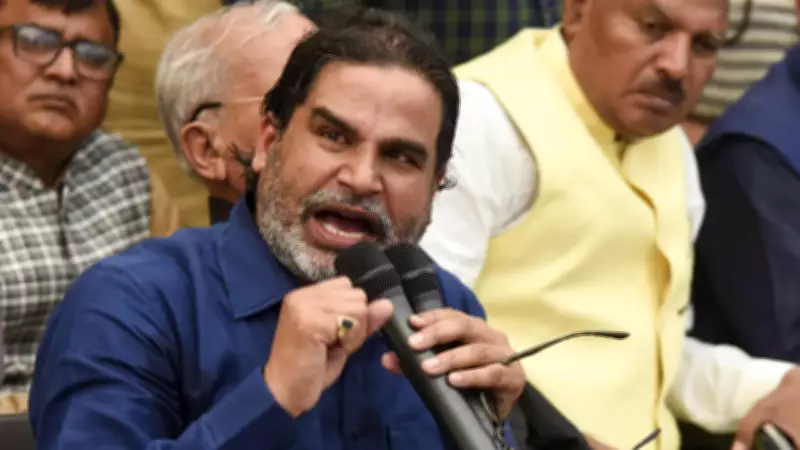
In a significant political development, former election strategist Prashant Kishor's Jan Suraaj Party has approached the Supreme Court of India, challenging the conduct of the 2025 Bihar Legislative Assembly elections. The party has filed a petition seeking fresh polls in the state, alleging serious violations of the Model Code of Conduct by the Bihar government.
Supreme Court Hearing Scheduled
The plea is expected to be listed for hearing on Friday before a bench comprising Chief Justice of India Surya Kant and Justice Joymalya Bagchi. This legal move comes after the Jan Suraaj Party failed to secure any seats in the recently concluded assembly elections, marking a substantial setback for the new political entity.
Allegations of Model Code Violations
In its detailed petition, the Jan Suraaj Party has made serious allegations against the Bihar government. The party claims that the state administration violated election norms by transferring Rs 10,000 each to women beneficiaries under the Mukhyamantri Mahila Rojgar Yojana after the announcement of the election schedule.

The controversial scheme provides an initial grant of Rs 10,000 to women to help them establish small businesses, with the stated objective of promoting self-employment and enhancing women's economic empowerment across Bihar. However, the timing of these transfers has raised questions about potential electoral influence.
Legal Framework Invoked
The petition has specifically sought directions to the Election Commission of India to exercise its constitutional powers. The party has invoked Article 324 of the Constitution, which vests the Election Commission with superintendence, direction, and control over the conduct of elections.
Additionally, the petition references Section 123 of the Representation of the People Act in connection with the direct transfer of funds to women voters in Bihar. This legal framework addresses corrupt practices and electoral offenses that could potentially influence voting patterns.
Electoral Performance Analysis
The Jan Suraaj Party, which had positioned itself as a potential "third force" in the contest between the ruling National Democratic Alliance (NDA) and the opposition Mahagathbandhan (MGB), failed to win a single seat in the Bihar Assembly elections. The NDA retained power with an impressive 202 seats, while the MGB secured 35 seats in the 243-member assembly.
Launched after an extensive padyatra (foot march) across Bihar, Jan Suraaj contested 236 constituencies during the elections. The party's campaign strategy relied heavily on social media outreach and promised a new political approach centered on meritocracy, employment generation, curbing youth migration, and improving governance systems.
Campaign Strategy and Results
Despite conducting a high-profile campaign and significant online presence, the party faced substantial electoral disappointment. Jan Suraaj lost its security deposit in 236 of the 238 seats it contested, indicating minimal voter support despite considerable campaign efforts.
The election results suggested limited conversion of online outreach into actual electoral support in Bihar, where traditional factors such as caste dynamics, local networks, and established political alliances continue to play decisive roles in determining electoral outcomes.
Election Timeline and Context
The Bihar Assembly elections were conducted in two phases on November 6 and November 11, with the final results announced on November 14. The electoral process witnessed intense competition between established political formations, with the Jan Suraaj Party attempting to break the traditional bipolar political landscape of the state.
This legal challenge represents a significant development in post-election Bihar politics, potentially setting important precedents regarding the implementation of welfare schemes during election periods and the enforcement of the Model Code of Conduct by constitutional authorities.