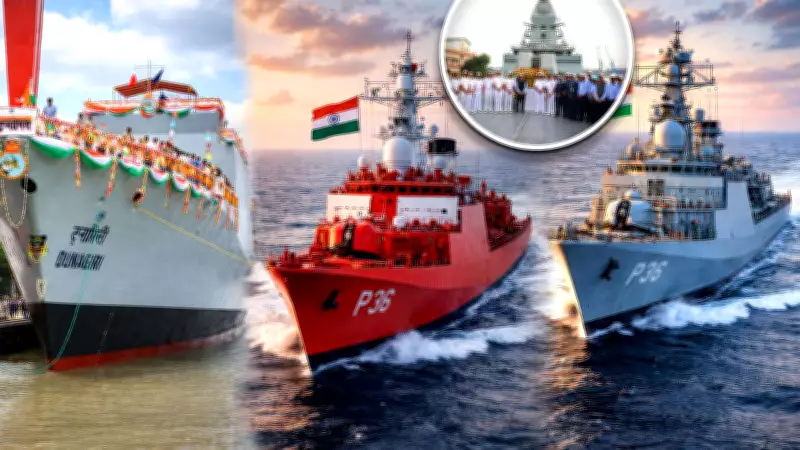
Indian Navy Receives Major Capability Boost with Triple Vessel Induction
In a landmark development for India's maritime defense, the Indian Navy has simultaneously commissioned three advanced vessels, representing a substantial enhancement of its operational capabilities across multiple domains. This strategic induction occurred on a single day, underscoring the Navy's accelerated modernization efforts.
Three Specialized Platforms for Comprehensive Maritime Dominance
The newly inducted vessels include a state-of-the-art stealth guided-missile frigate, a dedicated anti-submarine warfare platform, and a sophisticated large survey vessel. This diverse combination reflects a deliberate approach to building a balanced and integrated naval force structure.
The stealth frigate is designed to significantly bolster the Navy's long-range strike capabilities and air defense systems. Its advanced stealth features enhance survivability and operational effectiveness in contested maritime environments.

The anti-submarine warfare platform addresses the growing threat of underwater adversaries, particularly in coastal and littoral regions. This vessel strengthens India's ability to detect, track, and neutralize submarine threats, a critical capability given the increasing submarine activity in regional waters.
The large survey vessel provides essential support capabilities through advanced seabed mapping and hydrographic intelligence gathering. This platform enhances maritime domain awareness, navigation safety, and supports both military operations and civilian maritime activities.
Strategic Shift Toward Integrated Force Structure
This triple induction represents more than just numerical growth. It signals a strategic shift in naval philosophy, moving beyond a sole focus on frontline combat platforms toward building a more comprehensive, layered capability. The Navy is now emphasizing an integrated force structure that combines offensive assets with critical enabling capabilities.
The inclusion of the survey vessel alongside combat platforms demonstrates this holistic approach, recognizing that maritime dominance requires not just firepower but also superior intelligence, surveillance, and environmental awareness.
Context of Growing Strategic Competition
This development comes amid increasing strategic competition in the Indian Ocean Region, where control of sea lanes, surveillance capabilities, and undersea awareness are becoming as crucial as traditional naval firepower. The induction of these three vessels directly addresses these evolving strategic requirements.
The Indian Ocean has witnessed growing naval presence from multiple powers, making enhanced maritime capabilities essential for protecting India's national interests and maintaining regional stability.
Domestic Shipbuilding Ecosystem Matures
A significant aspect of this induction is the high level of indigenous content across all three platforms. This achievement highlights the growing maturity and capability of India's domestic shipbuilding ecosystem, reducing dependence on foreign suppliers and enhancing strategic autonomy.
The successful development and commissioning of these advanced vessels demonstrate India's progress in defense manufacturing and technological self-reliance in the naval domain.
This triple vessel induction marks a pivotal moment in the Indian Navy's modernization journey, providing enhanced capabilities across surface warfare, anti-submarine operations, and maritime intelligence gathering. It strengthens India's position as a significant maritime power in the strategically vital Indian Ocean Region.