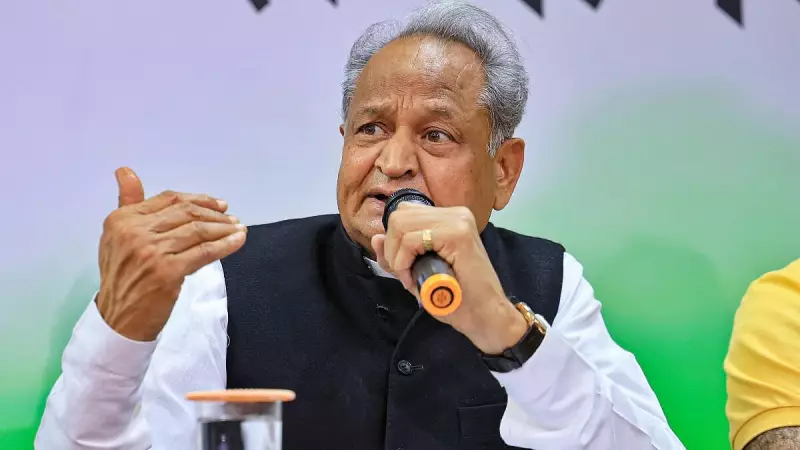
Former Rajasthan Chief Minister and senior Congress leader Ashok Gehlot has launched a sharp critique against the central government, labeling the ongoing reports of atrocities against the Hindu minority in Bangladesh as a "blot on humanity." In a strongly-worded statement, Gehlot framed the situation as a significant diplomatic failure for India.
Gehlot's Stern Condemnation and Political Charge
Ashok Gehlot expressed deep concern over the alleged violence and discrimination faced by the Hindu community in neighbouring Bangladesh. He did not mince words, directly implicating the Indian government's foreign policy approach. The veteran Congress leader stated that it is profoundly worrying that a nation, whose very creation India supported historically, is witnessing such incidents against its minority population. His remarks, issued on January 6, 2026, add a potent political dimension to the international human rights issue.
Gehlot's statement suggests a rupture in the traditionally close ties between India and Bangladesh, implying that New Delhi's diplomatic channels have not been effective in safeguarding the interests and safety of Hindus across the border. This critique targets the core of the ruling BJP-led government's foreign policy narrative, which often highlights strong relations with neighbouring countries.

The Context of India-Bangladesh Relations
The historical context is crucial to understanding Gehlot's pointed remark. India played a pivotal role in Bangladesh's liberation war in 1971, which led to the country's independence from Pakistan. For a senior Indian politician to state that this ally has "turned against it" in the context of minority safety is a serious allegation. It shifts the discourse from domestic Bangladeshi affairs to a bilateral diplomatic concern for India.
The issue of the rights and security of Hindu minorities in Bangladesh has been a persistent point of discussion and concern in Indian political circles, often raised by various groups. Gehlot's intervention brings it to the forefront through the lens of diplomatic accountability, questioning the efficacy of the current government's engagement with Dhaka on this sensitive matter.
Political Repercussions and Demands for Action
By calling the situation a "blot on humanity," Gehlot has elevated it to a moral failing of global proportions. His statement is likely intended to pressure the Centre into taking more visible and concrete diplomatic steps. The implicit demand is for the Indian government to leverage its relationship with Bangladesh to ensure the protection of minority communities more robustly.
This criticism from a prominent opposition figure ensures that the topic will remain in political discourse. It frames the government's performance not just on domestic issues but also on its ability to protect the interests of cultural and religious kin abroad. The statement, released via PTI, is a clear political manoeuvre to question the government's stance on secularism and minority protection beyond India's borders.
As reactions unfold, the focus will be on whether the Indian government issues a formal response to Gehlot's charges and how it addresses the complex interplay between diplomatic relations and concerns for minority welfare in a neighbouring sovereign nation.