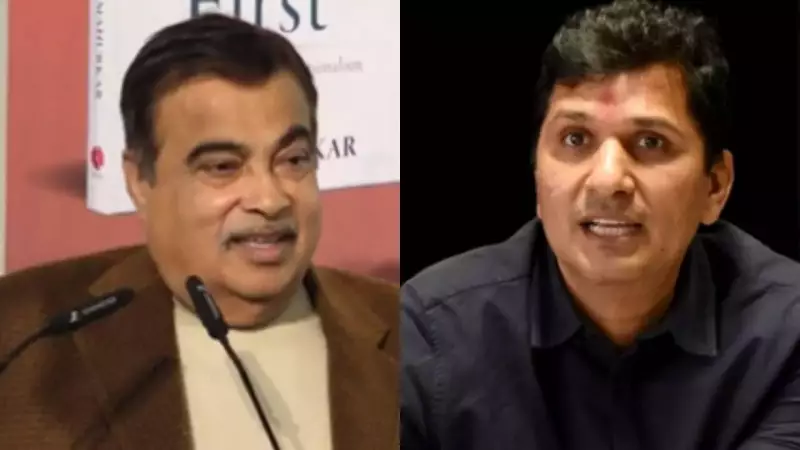
In a candid admission that has stirred political circles, Union Minister for Road Transport and Highways, Nitin Gadkari, has publicly stated that the transport sector is responsible for a significant share of the national capital's toxic air. His remarks, which directly connect pollution to public health, have been welcomed by Aam Aadmi Party (AAP) leader Saurabh Bharadwaj as a rare voice of truth.
Minister's Candid Admission on Health and Pollution
Speaking at the launch of a book titled 'My Idea of Nation First – Redefining Unalloyed Nationalism' by journalist Uday Mahurkar on Tuesday, Gadkari expressed deep personal concern over Delhi's deteriorating air quality. He revealed that even a short stay in the capital adversely affects his health. "I stay in Delhi for just two days and end up getting infections. Why is Delhi suffering so much from pollution?" the minister questioned.
Gadkari went a step further by acknowledging his own ministry's role in the crisis. "I am the transport minister, and 40% of the pollution is caused by us," he stated, putting a definitive number on the sector's contribution. This admission stands in stark contrast to the central government's previously stated position downplaying the direct link between air pollution and lung diseases.

Political Reaction and Public Health Crisis
AAP's Delhi minister and prominent leader, Saurabh Bharadwaj, swiftly responded to Gadkari's comments. He expressed gratitude that a senior leader was finally articulating the grim reality faced by Delhi's residents. "I want to thank him that at least there is one leader who is raising the voice of the common people and telling the truth," Bharadwaj said.
He emphasized the scale of the public health emergency, claiming that around 60 per cent of Delhi's population has fallen sick in the last three months due to the poor air quality. Bharadwaj pointed out that Gadkari's statement "directly contradicts the central government's claim that pollution has no relation to lung diseases."
Linking Pollution to Economic Policy and Nationalism
Gadkari framed the environmental issue within a broader economic and nationalistic context. He highlighted India's heavy financial burden due to fossil fuel imports, which he estimated at a staggering Rs 22 lakh crore annually. The minister argued that this massive expenditure on importing polluting fuels is antithetical to the concept of true nationalism.
"If there is any true nationalism today, it lies in reducing imports and increasing exports," Gadkari asserted. He posed a critical question to push for self-reliance: "By spending so much money, we are polluting our own country. Can't we become self-reliant in alternative fuels and biofuels?" This connects the fight for cleaner air directly with the national goals of energy independence and economic strength.
The minister's forthright comments have opened a new front in the ongoing debate over Delhi's perennial pollution crisis, shifting focus squarely onto the responsibilities of the transport sector and the urgent need for a transition to sustainable fuels.