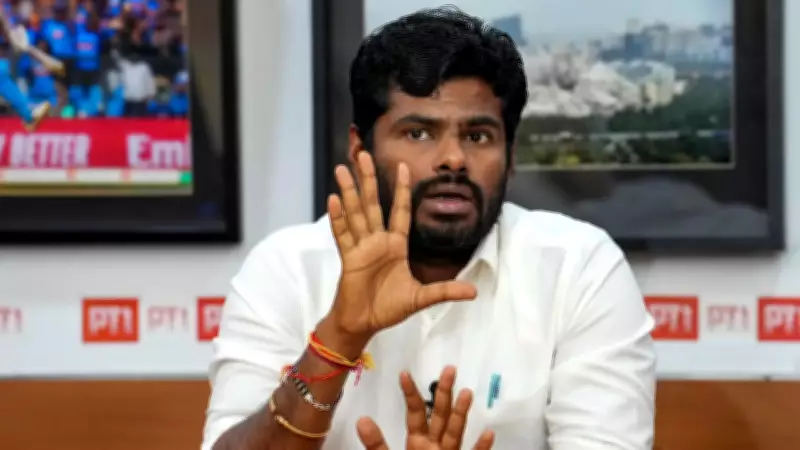
NEW DELHI: Former BJP Tamil Nadu state president K Annamalai has questioned the extensive security measures for the NEET-UG re-examination scheduled for June 21. He remarked that the involvement of CRPF, CISF, and multi-level oversight with direct monitoring from the Prime Minister's Office seemed like arrangements to "buy high-level, classified, military-grade software."
Annamalai's Concerns
In a post on X, Annamalai detailed the security framework: "Two-tier CRPF+CISF escort with IAF airlift. 4-layer CCTV with AI surveillance. Biometric & facial recognition before entry. Multiple layers of frisking. Multi-level oversight with direct monitoring from the Prime Minister’s office. Yes, you read it right. But these are not arrangements to buy high-level, classified, military-grade software. These are the arrangements made by the Ministry of Education for the NEET retest scheduled for 21st June 2026."
He acknowledged that students would appreciate efforts to prevent paper leaks but argued that increased scrutiny, extended frisking, and an overall exam time increase from 180 to 195 minutes would "only add to their already ballooning exam pressure." He also questioned whether the arrangements aligned with the National Education Policy (NEP) 2020, which aims to reduce exam-related stress.

Annamalai further highlighted difficulties candidates faced in downloading admit cards and urged authorities to resolve logistical issues to avoid compounding students' anxieties. He stated, "While the government has taken measures to contain leaks, they have forgotten the additional burden they have imposed on a young student before they take up an assessment... dissolving the entire purpose of our exam system and the NEP 2020’s goal to reduce 'Exam Stress'."
BJP's Response
In response, BJP leader Selva Kumar defended the Centre's approach, noting that Prime Minister Narendra Modi personally monitored the paper leak issue and Education Minister Dharmendra Pradhan worked continuously for a month. The security framework was formulated after consultations with multiple ministries, including Defence, Communications, and Education, and was presented to the Supreme Court.
Kumar acknowledged the additional 15 minutes for security checks but stressed it was a temporary measure to ensure a leak-free exam. "This is a one-time measure and from next time it will all be computer-based," he said.
He also accused "anti-BJP forces" of politicizing the issue after protests over the examination controversy failed to gain traction. "We understand that after the Cockroach Party’s protests failed at multiple locations, anti-BJP forces have now activated their newly acquired toolkit," he added.
Security Framework Details
The Ministry of Education has implemented an extensive security framework for the examination, including CRPF and CISF escorts for question papers, Indian Air Force airlift support, AI-enabled multi-layer CCTV monitoring, biometric and facial verification of candidates, multiple rounds of frisking, and real-time oversight by the Prime Minister's Office.