Economist Parakala Prabhakar Terms Bengal SIR as 'Bloodless Political Genocide'
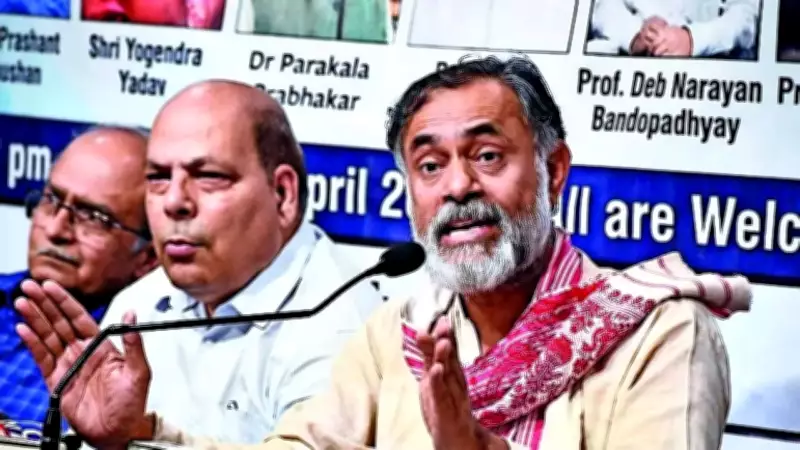
Economist Parakala Prabhakar has strongly criticized the Special Intensive Revision (SIR) process in West Bengal, labeling it a 'bloodless political genocide' during a press conference in Kolkata on Sunday. The event was organized by the Educationists' Forum, where Prabhakar and other speakers voiced deep concerns over the alleged large-scale disenfranchisement of voters.
Allegations of Voter Disenfranchisement
According to Prabhakar, the SIR is leading to significant voter disenfranchisement, effectively creating two distinct classes of people in the country. "While one group retains voting rights, the other is stripped of this fundamental feature of citizenship," he emphasized. He argued that although those deprived remain citizens, losing voting rights undermines a core aspect of their civic identity.
Prabhakar warned that this transformation could have far-reaching effects, impacting not only society and culture but also the economy. He urged for the formation of an association dedicated to deleted voters to advocate for the restoration of their voting rights.

Concerns from Legal and Political Experts
Supreme Court lawyer Prashant Bhushan, along with activists Yogendra Yadav and Akhil Swami, also expressed their apprehensions at the conference. They highlighted that voter names are being deleted from the SIR list under the pretext of 'logical discrepancies,' a term they find dubious.
Om Prakash Mishra, a professor and member of the Educationists' Forum, questioned the validity of these discrepancies, stating, "The so-called logical discrepancies had no logic. If there were discrepancies, how could they be logical?"
Political Motivations and Data Analysis
Yadav went further, describing SIR as a 'Special Impediment Removal' exercise by the Election Commission, allegedly serving the political agenda of the Bharatiya Janata Party (BJP). "I had said Bihar was a trial run to target Bengal. I was exactly afraid of this. If they (BJP) have to win Bengal, it is necessary to cut its voter list. That's what SIR is," he asserted.
He claimed that targeted deletions are being carried out citing logical discrepancies, with 65% of omitted voters being Muslims. Many individuals, he added, have lost their voting rights due to minor issues such as spelling mistakes, spaces between names, or incorrect age differences.
Questioning the data provided by authorities, Yadav pointed out discrepancies in unmapped voter proportions: "The EC and the BJP allege that the unmapped figure was very low in Bengal. Artificially low. In Bengal, it was 4.5%, I checked. What was the unmapped proportion in Chhattisgarh? It was 3.5% in MP and 1.6% in Rajasthan."
Calls for Judicial Intervention and Warnings
The speakers collectively urged the Supreme Court to find a solution to restore citizens' voting rights. Prashant Bhushan noted that adjudication of such issues has been carried out only in Bengal, raising concerns about fairness and consistency.
Bhushan issued a stark warning, suggesting that if this trend continues, the central government could face an uprising from citizens who elect governments to govern on their behalf. "This disenfranchisement threatens the very foundation of our democracy," he cautioned.
The press conference underscored growing tensions over electoral processes in Bengal, with experts calling for transparency and justice to uphold democratic principles.