Election Commission Clarifies Key SIR Document Policy in West Bengal
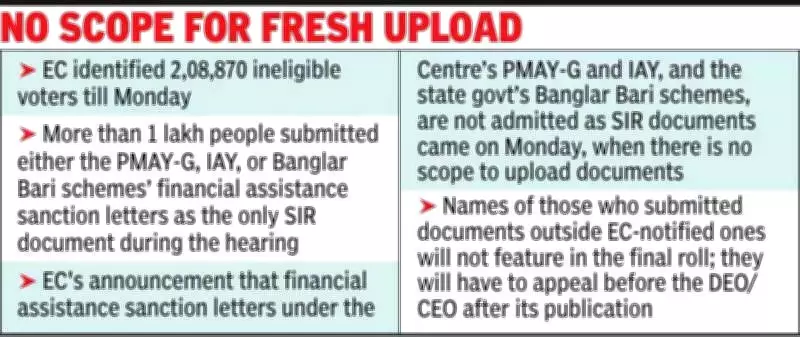
In a significant development following the conclusion of the Summary Revision of Electoral Rolls (SIR) hearings in West Bengal, the Election Commission of India (EC) issued a crucial clarification on Monday. The EC explicitly stated that financial assistance sanction letters issued under the central government's Pradhan Mantri Awas Yojana-Gramin (PMAY-G) and Indira Awas Yojana (IAY), as well as the state government's Banglar Bari schemes, will not be considered as valid documents for the SIR process.
Timing and Context of the Clarification
The EC's clarification was delivered in response to a formal query submitted by the office of West Bengal's Chief Electoral Officer (CEO), Manoj Agarwal, on January 21. Notably, this announcement came after the deadline for electors to submit any fresh documents had already passed, raising immediate concerns about procedural fairness. According to Commission sources, more than 1 lakh individuals had submitted these financial assistance sanction letters as their sole SIR document during the hearings.
Political Reactions and Legal Challenges
The Trinamool Congress (TMC) swiftly condemned the EC's decision, labeling it a deliberate violation of Supreme Court orders. Kalyan Banerjee, a TMC MP and senior lawyer, declared his intention to raise this issue in the Supreme Court, describing the decision as "arbitrary". The Supreme Court is scheduled to next hear the Bengal SIR petition on February 20, potentially setting the stage for a legal showdown.

State Finance Minister Chandrima Bhattacharyya echoed these sentiments, alleging a direct violation of the Supreme Court order. She argued, "Sanction letters under PMAY-G, IAY, Banglar Bari (Gramin) are given only to those who have land. The CEO sought this clarification on January 21. In between, these documents were accepted by EC officials. A month later—and most importantly after the SIR hearings were complete—this clarification is being used. This is a direct attempt to disenfranchise genuine voters."
EC's Rationale and Instructions
The EC's letter to the CEO cited Paragraph 6 (viii) of the Supreme Court order dated February 9, which specifies that affected persons can rely on documents referred to by the EC in SIR notices. However, the Commission emphasized that its SIR instructions dated October 27 prescribe "Any Land/House allotment certificate by government" as an indicative document, explicitly excluding financial assistance sanction letters from schemes like PMAY-G, IAY, and Banglar Bari. The EC directed strict compliance with this interpretation.
Implications for Voters and Next Steps
A senior Commission official outlined the consequences for those affected: "Now, there is no scope for uploading documents. Those who submitted documents other than the notified ones will be deleted from the final roll, and they will have to appeal to the District Electoral Officer (DEO) within five days from the publication of the final list. If the issue is not resolved in five days, then they can apply to the CEO." This process could potentially disenfranchise thousands of voters who relied on these sanction letters as proof of residence or eligibility.
The clarification has sparked a heated debate over voter rights and electoral integrity in West Bengal, with political parties gearing up for legal battles and public scrutiny intensifying ahead of the final electoral roll publication.