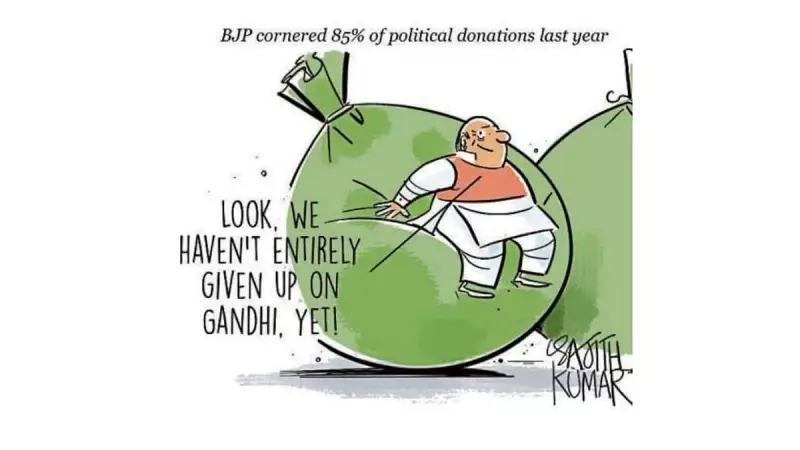
In its latest edition, Deccan Herald has published a pointed editorial cartoon that delves into the complex and often contentious relationship between modern Indian politics and the enduring legacy of Mahatma Gandhi. The artwork, titled "Haven't Given Up Gandhi Yet," serves as a visual commentary on the selective appropriation and presentation of symbolic figures in the nation's current socio-political landscape.
The Art of Political Satire
Editorial cartoons have long been a powerful medium for critique, using wit and imagery to convey what words sometimes cannot. This particular cartoon from Deccan Herald continues that tradition, employing visual metaphor to question the authenticity and consistency with which Gandhi's ideals are invoked today. The illustration captures a scene rich with irony, suggesting a gap between public professions of reverence and tangible actions on the ground.
The cartoonist skillfully uses familiar iconography associated with the Father of the Nation—the round spectacles, the humble attire, the spinning wheel—but places them in a context that prompts the viewer to reflect. The central message hinges on the idea of claiming a legacy without fully embracing its foundational principles of truth, non-violence, and communal harmony.

Symbolism and Contemporary Discourse
At its core, the cartoon interrogates how political and social entities engage with historical symbols. It raises pertinent questions about whether Gandhi is being remembered as a guiding moral compass or merely deployed as a convenient political totem. This is not just an artistic expression but a mirror held up to the ongoing debates about nationalism, heritage, and ideological ownership in India.
The phrase "Haven't Given Up Gandhi Yet," implied in the cartoon's narrative, carries a dual meaning. On one level, it can be read as a declaration of continued allegiance to his ideals. On another, more critical level, it might suggest a reluctant, performative adherence, a symbol not fully relinquished but perhaps not fully integrated into practice. The artwork challenges the viewer to decipher this ambiguity.
The Role of Media in Framing Dialogue
By choosing to feature this cartoon, Deccan Herald actively participates in shaping public discourse. It moves beyond straightforward reportage to offer an interpreted, opinion-based perspective that is central to editorial pages. Such content is vital for a vibrant democracy, as it encourages citizens to engage critically with the power structures and narratives that surround them.
The publication of this cartoon aligns with a long history of press cartooning in India, which has fearlessly commented on social issues, corruption, and political maneuvering. It underscores the media's role as a watchdog and a platform for diverse viewpoints, using satire as a tool to speak truth to power without resorting to inflammatory rhetoric.
The cartoon does not merely criticize; it invites introspection. It asks the audience to consider how the nation venerates its icons and what those icons truly represent in the modern era. Is Gandhi's philosophy a living, breathing guide, or has it been fossilized into mere imagery for ceremonial purposes? The drawing leaves this question hanging, compelling the reader to arrive at their own conclusion.
In conclusion, Deccan Herald's "Haven't Given Up Gandhi Yet" cartoon is a significant piece of contemporary political satire. It encapsulates a widespread sentiment regarding the use and misuse of historical figures in today's identity-driven politics. By blending artistic skill with sharp commentary, it contributes to the essential dialogue about the soul of the nation and the authentic preservation of its foundational values.