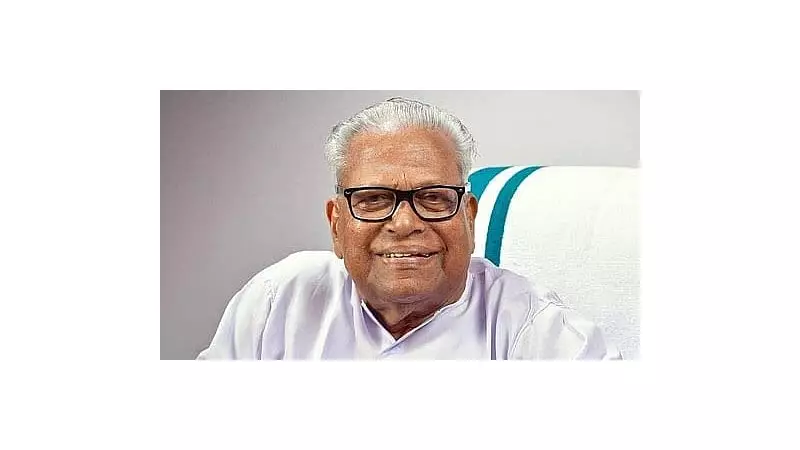
The Communist Party of India (Marxist) has made a significant departure from its long-standing policy by advocating for a posthumous Padma Vibhushan award for its veteran leader, V.S. Achuthanandan. In a notable move, the party has emphasized that the final decision rests with the family of the late leader, reflecting a nuanced approach to state honors.
A Break from Tradition
Historically, the CPI(M) has maintained a principled stance of declining state awards, viewing them as incompatible with its ideological framework. This tradition dates back to the party's inception and has been consistently upheld over the decades. The call for Achuthanandan's recognition, therefore, represents a potential shift in this rigid position, sparking discussions within political circles.
Precedent with EMS Namboodiripad
This is not the first instance where a CPI(M) leader has been considered for such an honor. In 1992, the then Congress government led by Prime Minister P.V. Narasimha Rao selected E.M.S. Namboodiripad, a founding member of the CPI(M), for the Padma Vibhushan award. He was chosen alongside Bharatiya Janata Party leader Atal Bihari Vajpayee, highlighting a cross-party acknowledgment of contributions.

However, it is widely reported that EMS, adhering to the party's ethos, declined the award. This historical context adds depth to the current situation, as the CPI(M) now navigates the delicate balance between honoring a stalwart and maintaining ideological purity.
VS Achuthanandan's Legacy
V.S. Achuthanandan, a prominent figure in Indian politics, served as the Chief Minister of Kerala and held various leadership roles within the CPI(M). His decades of service, marked by advocacy for social justice and anti-corruption measures, have left an indelible mark on the state's political landscape. The party's push for a posthumous award underscores his enduring influence and the respect he commands across party lines.
Family's Role in the Decision
In a respectful gesture, the CPI(M) has explicitly stated that the decision to accept or decline the Padma Vibhushan should be made by Achuthanandan's family. This approach acknowledges the personal and emotional dimensions of such honors, moving beyond purely political considerations. It also allows the family to reflect on his legacy and values in making their choice.
Implications for Indian Politics
This development could signal a broader reevaluation of how leftist parties in India engage with state symbols and awards. As political dynamics evolve, the CPI(M)'s stance may influence other groups to reconsider their positions on national recognition. The outcome of this case will be closely watched for its potential to set new precedents in the intersection of ideology and honor.
Ultimately, the CPI(M)'s call for a posthumous Padma Vibhushan for V.S. Achuthanandan, while deferring to the family, highlights the complex interplay between tradition, tribute, and political identity in contemporary India.