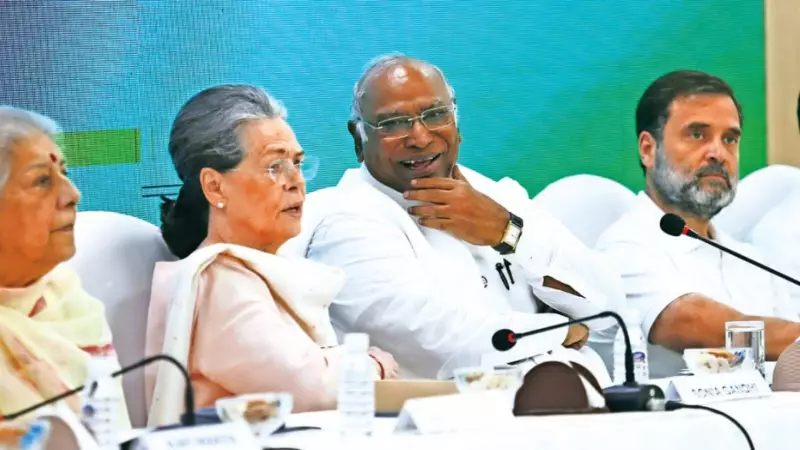
The Congress party's top decision-making body, the Congress Working Committee (CWC), is set to convene in New Delhi on Saturday, December 27, 2025, to chart a major political offensive. The central focus of the meeting will be the recent renaming of the landmark rural jobs guarantee scheme, MGNREGA, by the ruling BJP government.
From Legacy to Political Battlefield
This strategic pivot comes after the party's recent "vote chori" (vote theft) campaign failed to gain significant traction with the public. Party insiders view the government's move to replace the UPA-era Mahatma Gandhi National Rural Employment Guarantee Act with the VB-G RAM G Act, 2025 as both a compulsion and a crucial opportunity.
It is a compulsion because MGNREGA is widely seen as the Congress-led UPA government's marquee achievement, credited with bringing electoral success. The party feels it must be seen vigorously defending its legacy. Simultaneously, it presents an opportunity to reconnect with its core social justice agenda and the rural and marginalised voters—Dalits, OBCs, and minorities—a pitch consistently made by Leader of Opposition Rahul Gandhi.

Building a Nationwide Campaign
In the week leading up to the CWC meeting, senior Congress leaders have already hit the ground running. Former Union Ministers including P Chidambaram, Jairam Ramesh, Salman Khurshid, and Anand Sharma, along with other leaders like Pawan Khera and Rajeev Shukla, have held press conferences across the country. Between December 19 and 22, top leaders addressed at least 50 such events to publicise the party's stance.
On December 20, Congress Parliamentary Party chairperson Sonia Gandhi released a video statement, declaring the party's readiness to counter the BJP's "attack" on MGNREGA. A CWC member expressed hope, stating, "If we can create sufficient pressure on the government, this is an issue that they may have to go back on."
The CWC will specifically deliberate on how and when to mobilise a large-scale movement on this issue, akin to the momentum generated during Rahul Gandhi's Bharat Jodo Yatra from September 2022 to January 2023.
Electoral Calculus and Opposition Unity
The Congress believes shifting the narrative to bread-and-butter livelihood issues is an electorally smarter move, especially in a year when four major states—West Bengal, Tamil Nadu, Kerala, and Assam—are headed for polls. The party calculates that a direct attack on policies affecting the rural populace will resonate more than critiques of institutional capture.
Furthermore, the new law, which shifts a significant financial burden to states, could become a rallying point for Opposition unity. It offers common ground with other parties in the INDIA bloc, including those with whom relations have been strained, such as the Trinamool Congress (TMC). The TMC government in West Bengal has already renamed its state rural jobs programme after Mahatma Gandhi, signalling potential alignment on the issue.
However, the Congress faces inherent challenges. It is not a cadre-based party known for swift mobilisation, and it has historically struggled to sustain momentum on issues like demonetisation, GST, and the Rafale deal. While the party is not entirely abandoning the "vote chori" campaign, leaders admit it did not find many takers during the recent Bihar Assembly elections, necessitating this strategic pivot.
As one leader put it ahead of the crucial meeting, "We do hope we can sustain pressure on this issue, and with this hope, we meet on Saturday." The outcome of the CWC deliberations will likely set the tone for the Congress's political strategy in the coming months.