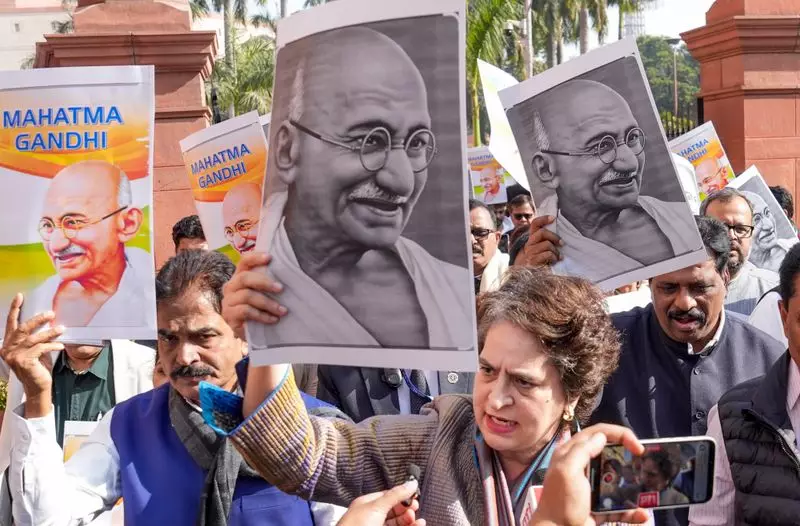
The Congress party has launched a fierce attack on the Narendra Modi-led government, accusing it of reversing two decades of socio-economic progress by repealing the Mahatma Gandhi National Rural Employment Guarantee Act (MGNREGA). The party's primary allegation is that the government bypassed all established parliamentary conventions to push through the repeal of the landmark rural job guarantee scheme.
A 'Black Day' for Parliamentary Democracy
Senior Congress leader and Rajya Sabha MP, Jairam Ramesh, spearheaded the criticism. He declared the day of the repeal as a 'black day' for India's parliamentary democracy. Ramesh emphasized that the government's move to dismantle MGNREGA was executed by sidestepping crucial parliamentary procedures that are designed to ensure thorough scrutiny and debate on matters of significant public importance.
He argued that the ruling dispensation did not allow for a dedicated discussion on the floor of the House regarding the repeal of such a pivotal law. This act, according to the Congress, demonstrates a blatant disregard for democratic norms and an attempt to avoid accountability. The party contends that the government is unwilling to face questions on its decision to end a scheme that has been a lifeline for millions of rural households.

The Core of the Controversy: Bypassing Debate
The heart of the Congress's grievance lies in the procedural approach taken. Jairam Ramesh stated that the government 'brazenly bypassed all parliamentary conventions' to repeal MGNREGA. This refers to the established practice where a law of this magnitude—one that has defined rural welfare policy for nearly 20 years—should be subjected to extensive debate, examination by committees, and a voting process that reflects the will of the people's representatives.
By allegedly shortcutting this process, the government has, in the opposition's view, undermined the very institution of Parliament. The Congress claims this sets a dangerous precedent where future governments could unilaterally dismantle other foundational welfare programs without legislative check or public discourse.
Accusations of Reversing Historic Progress
Beyond the procedural critique, the Congress framed the repeal as a substantive policy failure with severe human costs. Jairam Ramesh asserted that the Modi government has 'reversed two decades of historic progress' achieved under the MGNREGA framework.
The party highlighted the scheme's legacy since its enactment in 2005 by the Congress-led UPA government. They credited MGNREGA with:
- Providing a critical safety net for rural employment, especially during agricultural lean seasons and economic downturns.
- Empowering marginalized communities, including women and Scheduled Castes and Tribes, by guaranteeing work and wages.
- Creating durable community assets like water conservation structures, roads, and irrigation channels that strengthened rural infrastructure.
- Injecting liquidity into the rural economy, thereby boosting local demand and resilience.
The repeal, therefore, is portrayed not just as an administrative change but as an act that strips away a fundamental economic right and a tool for poverty alleviation. The Congress warns that this will lead to increased distress, inequality, and vulnerability among India's rural population.
The political battle over MGNREGA's repeal is now set to intensify. The Congress has positioned itself as the defender of parliamentary norms and rural rights, using this issue to challenge the government's approach to governance and welfare. The government, yet to issue a detailed counter to these specific allegations, will likely face sustained pressure in and outside Parliament to justify both the decision and the manner in which it was taken.