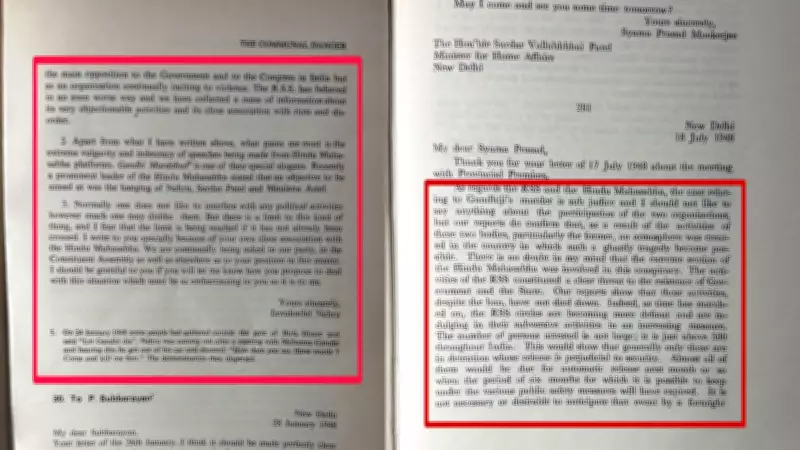
On the solemn occasion of Mahatma Gandhi's 78th death anniversary, also observed as Martyrs' Day, Congress leader Jairam Ramesh brought to light historical correspondence that has stirred political discourse. Ramesh shared letters written by Jawaharlal Nehru and Sardar Vallabhbhai Patel to Syama Prasad Mookerjee, which critically address the activities of the Hindu Mahasabha and the Rashtriya Swayamsevak Sangh (RSS).
Nehru's Letter: A Stark Critique of Hindu Mahasabha and RSS
In a post on social media platform X, Ramesh highlighted that Nehru penned his letter just two days before Gandhi's assassination. The letter, as depicted in the shared image, contains Nehru's sharp criticism of the Hindu Mahasabha and RSS, groups that often opposed Gandhi. Nehru expressed grave concerns, noting that the Hindu Mahasabha had conducted meetings in defiance of bans in cities like Pune, Ahmednagar, and Delhi, with speeches suggesting Gandhi was an impediment to the nation.
Nehru wrote, "The RSS has behaved in an even worse way and we have collected a mass of information about its very objectionable activities and its close association with riots and disorder." He further lamented the "extreme vulgarity and indecency of speeches being made from Hindu Mahasabha platforms," stating that while political activities are typically tolerated, the situation had reached an intolerable limit.

Nehru addressed Mookerjee due to his association with the Hindu Mahasabha, seeking clarity on his stance. "We are continually being asked in our party, in the Constituent Assembly as well as elsewhere, about your position in this matter. I should be grateful if you will let me know how you propose to deal with this situation, which must be as embarrassing to you as it is to me," he added.
Patel's Letter: Concerns Over RSS Threat to State Security
A few months later, on July 18, 1948, Sardar Patel also wrote to Mookerjee, echoing similar apprehensions. Patel's letter delved into the role of the RSS and Hindu Mahasabha in the context of Gandhi's murder, though he noted the case was sub judice. He emphasized that reports confirmed these organizations, particularly the RSS, created an atmosphere conducive to such tragedies.
Patel stated, "The activities of the RSS constituted a clear threat to the existence of Government and the State. Our reports show that those activities, despite the ban, have not died down. Indeed, as time has marched on, the RSS circles are becoming more defiant and are indulging in their subversive activities in an increasing measure."
Political Implications and Ramesh's Commentary
Ramesh used this revelation to critique contemporary politics, linking it to a Lok Sabha MP who, he claimed, is aligned with such ideologies and blessed by the Prime Minister. "Both are damning indictments of the self-declared custodians of nationalism. And to think that there is a Lok Sabha MP wedded to that ideology and blessed by the Prime Minister himself, who said that he could not choose between Gandhi and Godse. His mindset is revealing," Ramesh wrote in his post.
Additionally, Ramesh shared a link to Nehru's All India Radio address from January 30, 1948, following Gandhi's assassination, underscoring the historical significance of these events. Gandhi was assassinated by Nathuram Godse on this day in 1948, marking a pivotal moment in Indian history.
This sharing of letters on Gandhi's death anniversary serves as a poignant reminder of the ideological conflicts that have shaped India's political landscape, sparking renewed debates on nationalism and historical accountability.