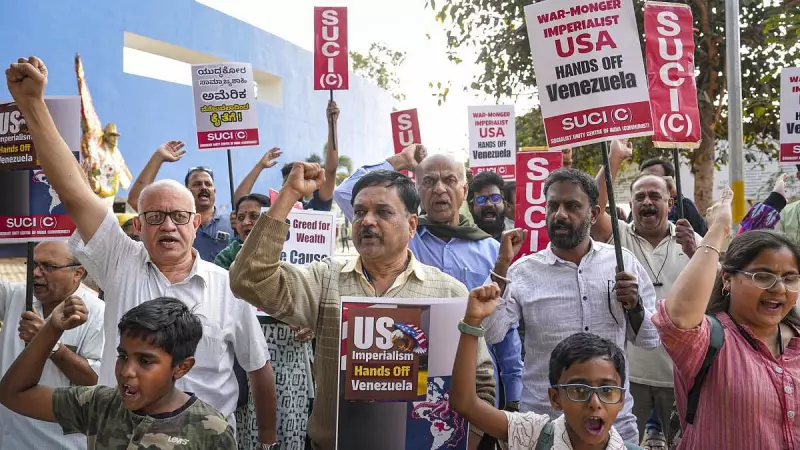
The Indian political landscape witnessed a sharp diplomatic critique as the principal opposition party, the Congress, along with leftist allies, launched a scathing attack on the Narendra Modi-led government's foreign policy stance. The focus of their ire is India's position on the ongoing political crisis in Venezuela, which they allege represents a dangerous and unprincipled shift towards the United States.
Opposition Alleges a Grave Foreign Policy Misstep
At the heart of the controversy is the accusation that the Indian government has violated the core principles of the United Nations Charter. The Congress party has formally flagged this alleged violation, arguing that New Delhi's silence and implicit support for US-led actions in Venezuela undermine the long-standing doctrine of non-interference in the internal affairs of sovereign nations. This principle has been a cornerstone of India's foreign policy since the era of the Non-Aligned Movement.
The Communist Party of India (CPI) echoed and intensified this criticism. In a strongly worded statement, the CPI expressed its "deep concern and anguish" over the position adopted by the Modi administration. The party accused the government of having "chosen to remain silent and, in effect, align itself with US imperialism" on this critical international issue. This alignment, according to the left party, marks a significant departure from India's traditional independent stance on global affairs.
The Context: Venezuela's Political Turmoil
The opposition's statements are rooted in the complex political situation in Venezuela, a nation rich in oil reserves but crippled by economic sanctions and internal division. The United States, along with several other Western nations, has recognized opposition leader Juan Guaidó as the legitimate president, rejecting the government of Nicolás Maduro. This has created a global diplomatic rift, with countries like Russia and China backing the Maduro government.
India's official position has been one of cautious diplomacy, calling for dialogue and peaceful resolution. However, the opposition contends that this public call for peace masks a quiet but clear tilt towards the US camp, especially in multilateral forums. The charge is that by not actively defending Venezuela's sovereignty and the UN Charter, the Modi government is effectively endorsing Washington's regime-change agenda.
Implications for India's Diplomatic Stature
The political firestorm has significant implications. Firstly, it frames the government's foreign policy as being susceptible to pressure from Washington, potentially damaging India's credibility as an independent voice in the Global South. Secondly, it provides a potent rallying point for a fragmented opposition to unite on a matter of national principle.
The criticism, dated and reported on 05 January 2026 by journalist Shemin Joy, highlights the growing political scrutiny of India's strategic choices. Analysts suggest that as India's global economic and strategic weight increases, its positions on contentious international issues will face greater domestic political examination. The Venezuela issue has now become a litmus test for the government's commitment to a multipolar world order versus a perceived bilateral alignment.
As the debate continues, the key questions remain: Is India's Venezuela policy a pragmatic adjustment to new geopolitical realities, or is it a fundamental betrayal of its founding diplomatic principles? The opposition, led by Congress and the Left, has clearly chosen its answer, setting the stage for a fierce parliamentary and public debate on the direction of Indian foreign policy.