CITU Leaders in Mangaluru Condemn Labour Codes as 'Extremely Dangerous' for Working Class
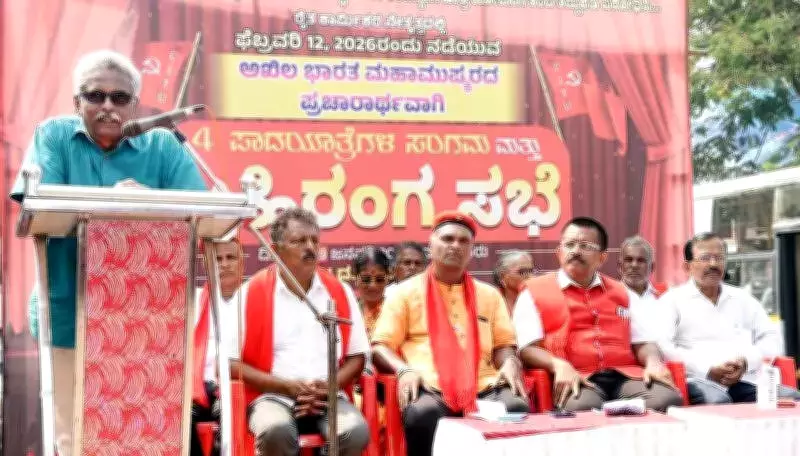
In a fiery address at the valedictory of a four-day protest march in Mangaluru, CITU Karnataka state president Meenakshi Sundaram launched a scathing attack on the central government's four labour codes, labeling them as extremely dangerous and accusing them of being designed to push the working class back into servitude. The event, held on Thursday, marked the culmination of organized marches opposing not only the labour codes but also the contentious Seed Bill and the Electricity (Amendment) Bill.
Labour Codes: A Death Sentence for Workers
Meenakshi Sundaram did not mince words, asserting that the four enacted codes would indeed be a death sentence for workers. He criticized both the central and state governments, pointing out that if the central government enacts these anti-people codes, the state Congress government is also preparing to draft complementary rules. This, he argued, demonstrates that both the BJP and Congress harbor animosity towards the working class, revealing a bipartisan disregard for labor rights.
Further expanding on his critique, Sundaram highlighted the broader impact of other legislation. He stated that by implementing dark legislation like the Seed Bill and the Electricity Bill, the governments have made the lives of farmers increasingly difficult. Additionally, he accused the central government of attempting to strangle the Mahatma Gandhi National Rural Employment Guarantee Scheme (MGNREGS) by shifting the financial burden of the employment guarantee scheme onto state governments. He described MGNREGS as the lifeline of rural people, emphasizing how such moves threaten their survival.

Betrayal of the Working Class and Call to Action
Echoing these sentiments, CITU Dakshina Kannada district general secretary Sunil Kumar Bajal declared that by implementing the labour codes, both the central and state governments have betrayed the country's working class. He emphasized the historical role of the working class, which once fought for India's Independence through sacrifice and struggle, and called for a renewed alliance. Bajal urged the working class to now join forces with the farming community to resist the aggressive policies of the ruling class, aiming to protect the country's survival and the people's lives from what he termed as oppressive measures.
Accusations of Looting and Divisive Politics
Presiding over the meeting, CITU Dakshina Kannada district president BM Bhat leveled serious accusations against the central government under Prime Minister Narendra Modi. He claimed that over the past 12 years, the government has completely looted the country's wealth and handed over all sectors to corporate companies, undermining public welfare for private gain.
Bhat also criticized the government for playing caste and religious politics, alleging that it is attempting to divide the country's people. He warned that instead of focusing on pressing livelihood issues, people are being distracted by unnecessary matters, and the implementation of the labour codes will push them into further hardship, exacerbating economic struggles and social fragmentation.
Protest Details and Tributes
The protest meeting began on a solemn note with a tribute to the late senior leader of the labour movement and AITUC state president, Ananth Subbarao. Participants offered flowers to his portrait, honoring his legacy in the fight for workers' rights.
Leaders of the four marches, who covered an impressive 175 kilometers across the district, were honored with red roses in recognition of their dedication. The marches commenced from key locations including Belthangady, Moodubidire, Talapady, and Mulki, converging near Ambedkar Circle in Mangaluru city. From there, the procession proceeded towards the Clock Tower, symbolizing a united front against the perceived anti-labour policies.
This protest underscores growing tensions in Karnataka over labor reforms, with CITU positioning itself as a vocal opponent of what it views as regressive legislation threatening the rights and livelihoods of workers and farmers alike.