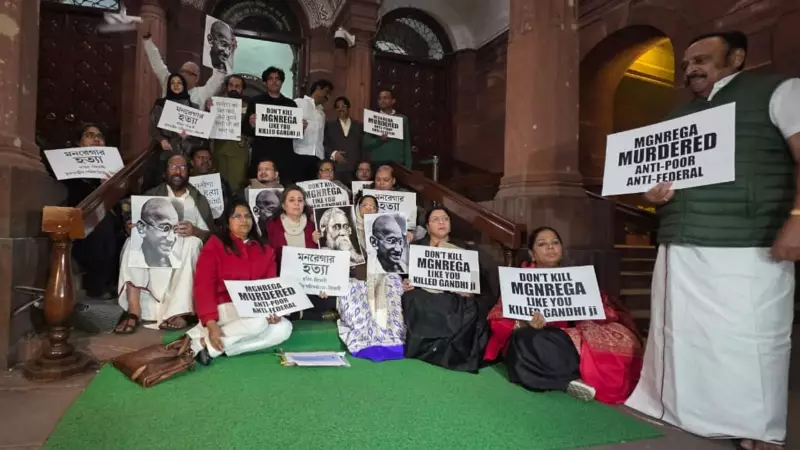
Senior Congress leader and former Finance Minister P Chidambaram has launched a scathing critique of the central government's move to repeal the Mahatma Gandhi National Rural Employment Guarantee Act (MGNREGA), calling it a deliberate attempt to erase the Father of the Nation from public memory and a "second killing" of his legacy.
The Erasure of a Name and a Legacy
In a strongly-worded opinion piece, Chidambaram pointed to Bill No. 197 of 2025, which repeals the MGNREGA of 2005. The Bill's text explicitly states that the Mahatma Gandhi National Rural Employment Guarantee Act "shall stand repealed." More significantly, the replacement scheme outlined in the Bill's Schedule I is named the 'Viksit Bharat—Guarantee for Rozgar and Ajeevika Mission (Gramin): VB—G RAM G Scheme.'
Chidambaram argues this move is not merely administrative but deeply symbolic. He connects it to a broader pattern, stating, "What started with Jawaharlal Nehru has now reached Mahatma Gandhi." He questions the BJP and its ideological parent, the RSS, on why they chose to remove Gandhi's name from the sole socio-economic programme bearing it, especially after the RSS had historically denied any role in his assassination.

Dismantling a Lifeline for the Poor
The columnist underscored MGNREGA's role as a critical safety net. He noted it was a lifeline for approximately 12 crore families, ensuring food security and providing dignity, especially for women and the elderly. The scheme's core, as conceived by the UPA government in 2004-05, was 'guaranteed livelihood security' with universal, demand-driven employment, central government-funded wages, and a legal entitlement to an unemployment allowance if work was not provided.
Chidambaram contends the new Bill systematically negates every one of these pillars. The proposed VB-G RAM G Scheme shifts from a central guarantee to a cost-sharing model (60:40 between Centre and States), making it state-specific. Funding will be based on a 'normative allocation' by the Centre, with any excess expenditure borne by states. This, he argues, covertly transforms it from a demand-driven to a supply-driven scheme.
Other critical changes include:
- No work provided during notified peak agricultural seasons (aggregating 60 days a year).
- The unemployment allowance can be as low as 25% of the notified wage and is subject to the state's economic capacity.
- The Centre becomes the ultimate arbiter, which Chidambaram labels as "anti-federal."
He warns that states, particularly those ruled by the BJP, may plead financial inability to gradually strangle the scheme.
A Monument of Neglect and a Final Blow
The article acknowledges that MGNREGA had suffered underfunding and neglect in recent years. Citing data, Chidambaram stated that while the scheme promised 100 days of work, the average hovered around 50 days per household. In 2024-25, only 40.75 lakh households out of 8.61 crore job card holders completed 100 days of work. Budgetary allocations fell from Rs 1,11,170 crore in 2020-21 to Rs 86,000 crore in 2025-26, and wage arrears mounted to Rs 14,300 crore.
However, he contrasts this with Prime Minister Narendra Modi's statement in Parliament on February 28, 2015, where Modi called MGNREGA a "living monument" to the UPA's failures and vowed not to scrap it. Chidambaram posits that the current repeal goes beyond policy reform; it is a "deliberate attempt to erase Mahatma Gandhi from the nation's memory."
In his concluding remarks, Chidambaram delivers a stark political warning: "The BJP's grave wrongs will not be forgiven by the people of India." He frames the repeal not just as an economic policy shift but as an ideological assault on the foundational figures and welfare principles of modern India.