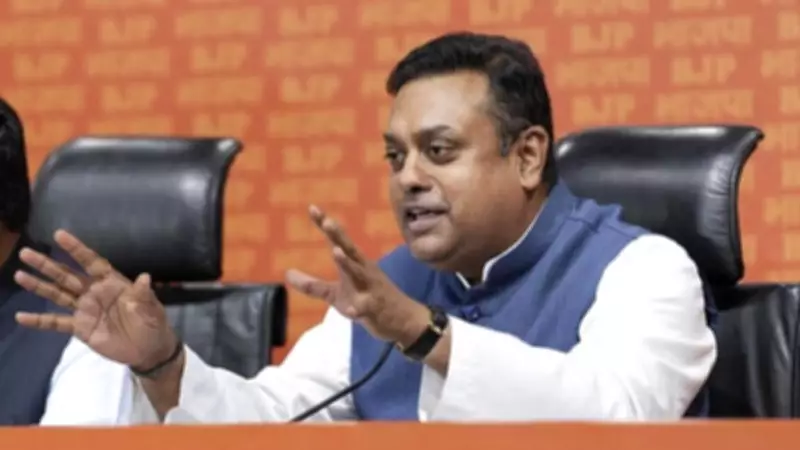
BJP Leader Sambit Patra Equates Congress with Ancient 'Corrupt' Dhananand Dynasty
In a sharp political attack, Bharatiya Janata Party (BJP) national spokesperson Sambit Patra has drawn a controversial historical comparison, likening the Congress party to the ancient Nanda dynasty, specifically referencing its last ruler Dhananand, whom he described as corrupt. The remarks were made during a public address, adding fuel to the ongoing political discourse in India.
Patra's Historical Analogy Sparks Political Debate
Sambit Patra asserted that if Dhananand, the ruler of the Nanda dynasty in ancient India, were alive today, he would recognize a modern parallel. "Dhananand would have said that there is a family party in India in the 21st century which is like the Nanda dynasty," Patra stated, directly targeting the Congress party's leadership structure. This analogy implies that both entities are characterized by dynastic control and alleged corruption, themes often highlighted by the BJP in its criticism of opposition parties.
The Nanda dynasty, which ruled parts of the Indian subcontinent from around 345 BCE to 321 BCE, is historically noted for its wealth and administrative prowess but also criticized in some texts for its autocratic and exploitative practices. By invoking this comparison, Patra aims to frame the Congress as an outdated and morally compromised political force, echoing the BJP's broader narrative against dynastic politics.

Context and Implications in Contemporary Indian Politics
This statement comes amid heightened political tensions, particularly in states like Telangana, where both parties are vying for influence. Patra's comments are part of a series of rhetorical strategies employed by BJP leaders to undermine the Congress's credibility, focusing on issues of governance and legacy. The reference to ancient history serves to deepen the critique, suggesting that the Congress's problems are not merely contemporary but rooted in a long-standing pattern of behavior.
Political analysts note that such analogies are designed to resonate with voters by simplifying complex historical narratives into digestible political messages. By labeling the Congress as similar to a 'corrupt' dynasty, the BJP seeks to reinforce its image as a party of change and anti-corruption, a key theme in its electoral campaigns. This move also aligns with the BJP's efforts to contrast its own leadership model, which it portrays as merit-based and dynamic, against the Congress's perceived reliance on familial succession.
Reactions and Broader Political Discourse
While the Congress party has not issued an immediate response to Patra's specific remarks, such comparisons often trigger heated exchanges in Indian politics. Historically, political parties have used metaphors and historical references to shape public perception, and this instance is no exception. The BJP's use of the Dhananand analogy may spark further debate on the role of dynastic politics in modern India, a topic that has been central to political discussions for decades.
In summary, Sambit Patra's comparison of the Congress to the ancient Nanda dynasty underscores the BJP's ongoing strategy to critique its main rival through historical lens. By framing the Congress as a continuation of corrupt, dynastic rule, the BJP aims to strengthen its political narrative ahead of future electoral battles. This development highlights the evolving nature of political rhetoric in India, where ancient history is increasingly invoked to comment on contemporary issues.