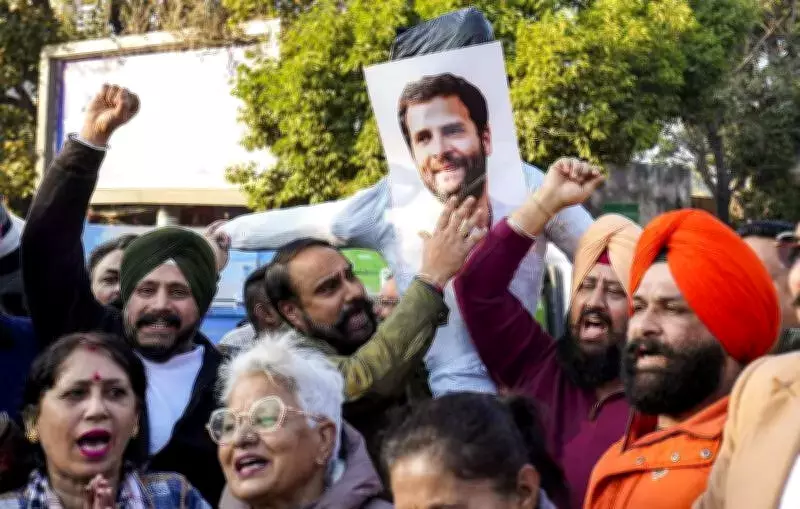
BJP Workers Stage Protest in Amritsar Over Rahul Gandhi's 'Traitor' Remark Against Union Minister
In a strong display of political dissent, Bharatiya Janata Party (BJP) workers gathered at Hathi Gate Chowk in Amritsar on Wednesday to protest against Leader of Opposition Rahul Gandhi. The demonstration was sparked by Gandhi's recent reference to Union Minister of State for Railways, Ravneet Singh Bittu, as a "traitor", a comment that has ignited widespread anger within the BJP ranks.
Protesters Raise Slogans and Burn Effigy in Symbolic Act
The protest saw BJP activists raising loud slogans against the Congress leader, culminating in the symbolic burning of his effigy. This act served as a powerful visual representation of their outrage over what they perceive as derogatory and unacceptable language used by senior political figures. The scene at Hathi Gate Chowk was charged with emotion as party members voiced their disapproval of Gandhi's remarks, which they argue undermine the dignity of public discourse.
BJP District President Accuses Congress of Historical Wrongs
Leading the protest, BJP district president Harvinder Singh Sandhu delivered a scathing critique of the Congress party. He alleged that the party has a long history of actions that have deeply hurt the religious sentiments of both Hindu and Sikh communities. Specifically, Sandhu pointed to the 1984 attack on the Golden Temple in Amritsar, a site revered globally by Sikhs, as a prime example of Congress's insensitivity.

Sandhu further elaborated on the 1984 anti-Sikh riots, stating that hundreds of innocent lives were lost in Delhi and other states during that tragic period. He emphasized that the Congress party has never shown genuine remorse for these events, which continue to resonate painfully in the collective memory of many Indians. This historical context, according to Sandhu, underscores the party's pattern of disrespect and negligence.
Pattern of Derogatory Language by Congress Leaders Highlighted
The BJP leader also highlighted that this incident is not an isolated one. He accused Rahul Gandhi and other senior Congress leaders of repeatedly using derogatory language against BJP figures. Sandhu recalled previous instances where Gandhi made objectionable remarks against Prime Minister Narendra Modi and several other BJP leaders, suggesting a consistent trend of inflammatory rhetoric from the opposition.
Sandhu made it clear that the BJP will not tolerate such language directed at its senior members. He asserted that the party stands firm in defending the honor and integrity of its leaders, calling for a more respectful and constructive political dialogue. The protest in Amritsar, therefore, serves as a stark warning to Congress to refrain from personal attacks and focus on substantive issues.
Broader Implications for Political Discourse in India
This protest underscores the escalating tensions between India's major political parties, with language and historical grievances becoming central points of contention. As the political landscape heats up, such incidents highlight the need for civility and accountability in public statements. The BJP's strong response in Amritsar reflects its commitment to challenging what it views as unacceptable behavior from the opposition, potentially shaping future interactions in the run-up to elections.
In conclusion, the protest at Hathi Gate Chowk is a vivid reminder of the deep-seated political rivalries in India. It calls attention to the importance of maintaining decorum in political discourse, while also addressing unresolved historical issues that continue to influence contemporary politics. The BJP's stance, as voiced by Sandhu, signals a zero-tolerance policy towards derogatory remarks, setting the stage for ongoing debates over language and respect in Indian democracy.