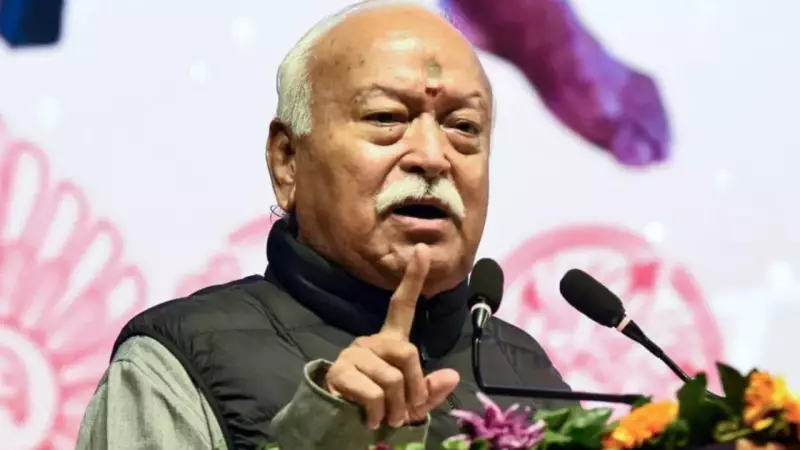
Rashtriya Swayamsevak Sangh (RSS) chief Mohan Bhagwat emphasized that the battle against what is termed 'love jihad' must originate within the household. Speaking at a women-centric event in Bhopal on Saturday, he outlined a multi-pronged strategy focusing on familial communication, awareness, and societal vigilance.
Addressing the Core: Family as the First Line of Defence
While addressing the 'Stri Shakti Samvad' programme, an RSS-organized discussion on women's societal role, Bhagwat delved into the contentious issue. The term 'love jihad' is used predominantly by right-wing groups to allege a conspiracy where Muslim men purportedly lure Hindu women into relationships for religious conversion.
Bhagwat pinpointed the lack of open dialogue within families as a primary concern. He urged households to introspect on how a young woman could be influenced by an outsider, suggesting that stronger internal communication is the foundational step. The RSS chief proposed a three-tiered approach to counter the phenomenon.

A Three-Level Strategy for Prevention
According to the RSS release, Bhagwat detailed the necessary efforts. The first level involves fostering continuous and meaningful communication within families. The second focuses on incultating awareness and self-protection skills among young women and girls.
The third pillar calls for effective legal and social action against individuals who commit such crimes. He further stressed that social organizations must stay alert and that society as a whole needs to mount a collective response to find a sustainable solution.
Women's Central Role in Society and Nation
Shifting to a broader perspective, Mohan Bhagwat lauded the indispensable role of women. He stated that religion, culture, and social order remain secure because of women, underlining the critical need for their empowerment and ideological orientation.
"The time has passed when women were confined to homes in the name of security," Bhagwat asserted. He highlighted that progress in families and society is achieved through the combined efforts of both men and women, making the awakening and enlightenment of both genders essential.
He described women as the central caregivers in families, crucial for maintaining balance, sensitivity, and order. Women, he noted, carry the sense of 'self' from the family to the wider society and the nation. With women constituting nearly half the population, Bhagwat called for intensified efforts to involve more women in social and national work.
On Mental Health and India's Global Stature
During his address, the RSS Sarsanghchalak also touched upon the subject of mental well-being. He advised that no family member should feel isolated and cautioned parents against imposing unrealistic expectations on their children. A meaningful life, he suggested, holds greater importance than mere conventional success.
Concluding on a nationalistic note, Bhagwat observed that India is emerging from a state of "mental slavery" and that the world is now looking towards the country with great expectations.
The event was attended by RSS leaders Ashok Pandey, the Madhya Bharat 'prant sanghchalak', and Somkant Umalakar, the 'vibhag sanghchalak', who shared the dais with Bhagwat during the significant dialogue in Bhopal.