Baramati Tragedy: A Political Loss That Exposes India's Aviation Safety Fault Lines
The untimely death of Maharashtra Deputy Chief Minister Ajit Pawar in a charter aircraft crash near Baramati represents not merely a profound political loss but a critical moment of reckoning for India's aviation safety framework. This tragedy transcends individual misfortune, reopening uneasy questions about the culture of political travel where urgency, influence, and packed schedules potentially compromise aviation safety margins.
The Fatal Flight: A Timeline of Events Over Baramati
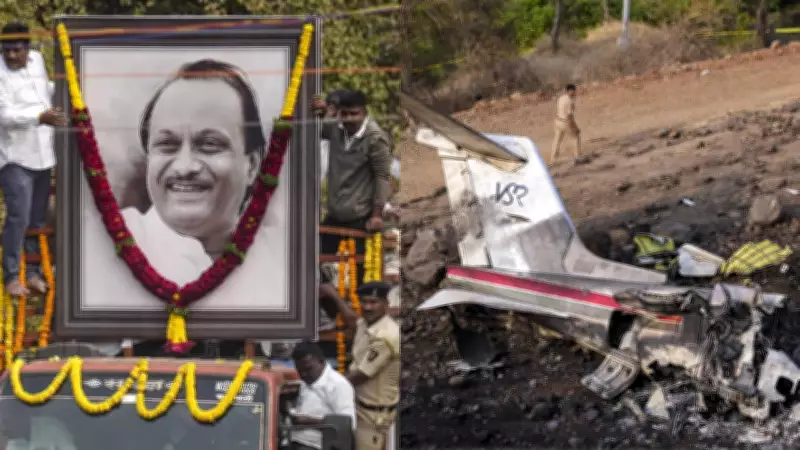
On a Wednesday morning, a Learjet 45 business jet departed Mumbai for Baramati, carrying Ajit Pawar and four other individuals. The aircraft established contact with Baramati Air Traffic Control at approximately 8:18 am. During the initial approach, the crew reported inability to sight the runway and executed a go-around maneuver. While visibility in the region was recorded at around 3,000 meters, patches of ground fog persisted—conditions known to degrade visual cues during critical landing phases.
Shortly thereafter, the crew indicated visual contact with the runway and received landing clearance around 8:43 am. Investigative reports suggest the landing clearance was not properly read back—a procedural deviation that will undergo intense scrutiny. Moments later, CCTV footage captured the aircraft banking sharply left before descending and crashing at approximately 8:44 am. No Mayday distress call was transmitted.

Aviation experts note such sudden banking could indicate multiple possibilities including technical malfunction, aerodynamic instability, or loss of situational awareness in marginal visibility conditions. The Aircraft Accident Investigation Bureau will meticulously analyze cockpit voice recordings, flight data, radar tracks, and maintenance records to reconstruct the final seconds.
Systemic Vulnerabilities in India's Political Aviation Ecosystem
Even before technical findings emerge, the context of this flight—a chartered jet operating to a regional airfield under tight political schedules—highlights systemic risk factors embedded within India's political aviation ecosystem.
Why VIP Air Travel Carries Inherently Higher Risks
Scheduled commercial airlines operate within deeply layered safety systems including dispatch teams, standardized maintenance programs, flight planning units, and continuous regulatory oversight. In contrast, non-scheduled charter aviation, while regulated, operates with significantly more operational variability. Charter operators differ substantially in scale, internal processes, and safety culture—some maintain airline-equivalent systems while others operate with leaner structures and fewer redundancies.
A Parliamentary Standing Committee in 2025 specifically warned that India's non-scheduled aviation sector is expanding faster than regulatory supervisory capacity. The committee highlighted multiple areas requiring strengthening including maintenance oversight, implementation of Safety Management Systems, pilot duty monitoring, and operational control structures.
Regional Airfields: Limited Infrastructure, Heightened Complexity
Baramati represents a category of regional airfields increasingly utilized for political access but lacking advanced instrument landing systems. Such airstrips depend more heavily on visual flying during final approach phases. Elevated terrain, limited navigational aids, and patchy weather monitoring add layers of operational complexity. In marginal weather conditions, pilots must make rapid decisions with substantially less technical assistance than available at major airports.
Smaller airfields frequently used for political access often lack comprehensive instrument landing systems, advanced ground radar, or precision approach aids found at major airports. Landings at these facilities depend more heavily on visual cues and pilot judgment, particularly during challenging conditions like haze, light fog, or shifting winds. Aviation history demonstrates that "marginal" weather—not severe enough to cancel flights yet not comfortably clear—represents where numerous accidents historically occur.

The Urgency Factor: Political Schedules and Operational Pressures
Political leaders in India represent among the heaviest users of chartered aircraft. Election cycles, district tours, crisis visits, and back-to-back public programs demand mobility that commercial airlines cannot provide. Chartered jets and helicopters offer flexibility, access to smaller towns, and ability to complete in hours what would otherwise require days. Over time, this convenience has evolved into institutional dependence.
A parallel aviation ecosystem now exists primarily to serve political, corporate, and VVIP clients—an ecosystem where aircraft bookings occur at short notice, routes change rapidly, and operators compete to provide speed and reliability. This demand structure means aircraft frequently fly multiple sectors daily, crews work tight rotations, and planning windows remain compressed. While none of this automatically implies unsafe operations, it creates environments where safety margins are thinner and systems rely heavily on strict procedural discipline to compensate for operational pace.
The pressure generated by political schedules represents a defining feature of this ecosystem. Leaders are expected to address rallies in different districts within hours, attend administrative reviews, and return to capital cities the same evening. When such itineraries are constructed, aviation becomes a tool to "make the programme happen." This expectation can translate, subtly but powerfully, into operational pressure.
In purely commercial environments, diversions remain inconvenient but routine. In political travel contexts, diversion can disrupt entire chains of scheduled events, increasing psychological weight behind decisions to attempt additional approaches. No regulation officially permits risk-taking, but culture and context significantly shape how decisions feel inside cockpit environments.
VSR Ventures: Political Connections and VIP Charter Operations
Founded in 2014 with initial aircraft including a Pilatus and Beechcraft B-200, VSR Ventures has rapidly expanded into one of India's largest charter operators, currently managing approximately 17 aircraft for VIP travel, medical evacuation, and charter services. The company stands among the country's biggest Learjet operators.
The company's success is partly attributed to strong political connections. Owner Captain V K Singh, former director of aviation at Bharat Hotels and ex-pilot with Air Charter Services, operates the firm alongside his son. Industry sources indicate VSR has become a preferred operator for government and political clients, partly due to willingness to extend credit—a common requirement given delayed payment cycles in VIP charter segments.
Even during investigations into the Baramati crash, VSR aircraft were utilized to ferry politicians for funeral-related travel, underscoring the company's continued role in high-profile political transportation. Charter companies often develop long-term relationships with political clients, sometimes extending credit arrangements that strengthen business ties. While not inherently problematic, this commercial reality highlights how deeply political mobility and private aviation have become intertwined.
Historical Pattern of Political Aviation Incidents
Ajit Pawar's crash has renewed attention to patterns of past near-misses and accidents involving VVIP travel. India's political history includes multiple tragedies where leaders lost lives in aircraft or helicopter crashes, often in challenging weather or terrain conditions. Alongside these are numerous incidents where chief ministers, union ministers, and senior figures survived emergency landings, technical snags, or aborted take-offs.
Helicopters forced down by weather, small jets overshooting runways, aircraft turning back due to cockpit warnings—these narratives recur across states and years. Each incident undergoes individual investigation, yet collectively they reveal how frequently political travel intersects with higher-risk operating environments including remote districts, temporary helipads, mountainous terrain, or minimally equipped airstrips. The exposure level of political travelers remains substantially greater, and exposure represents a core element of aviation risk.
Notable Historical Political Aviation Near-Misses
- Morarji Desai (1977): Then Prime Minister Morarji Desai survived a harrowing aircraft accident when his plane struck a tree branch during approach, losing one wing and engine mid-air. The aircraft crash-landed over bamboo groves on rain-soaked ground, cushioning impact despite severe cockpit damage.
- Ahmed Patel, Prithviraj Chavan, and Kumari Selja (2004): Senior Congress leaders survived a serious aircraft accident, receiving immediate medical attention and being declared safe.
- Sukhwinder Singh Badal (2009): Former Punjab Chief Minister encountered mid-flight helicopter technical faults, with pilot's timely response enabling safe landing without injuries.
- Ashok Gehlot (2011): Former Rajasthan Chief Minister survived helicopter emergency when rotor blade went out of alignment mid-flight, with pilot's skillful emergency landing averting disaster.
- Devendra Fadnavis (2017): Maharashtra Chief Minister experienced multiple aviation incidents including helicopter entanglement in power lines during takeoff in Latur, with quick pilot thinking preventing fatalities across several emergencies.
DGCA Under Strain: Regulatory Challenges in Expanding Aviation Landscape
India's aviation regulator faces increasingly complex challenges. Aircraft movements are rising rapidly, new regional routes are opening, and private aviation demand continues growing. Months before the Baramati accident, a Parliamentary Standing Committee report (tabled August 2025) had already warned that India's rapid aviation growth was outpacing regulatory oversight, particularly in non-scheduled aviation sectors encompassing private jets and charter aircraft.
The report highlighted that unlike scheduled commercial airlines, private and charter operations often demonstrate uneven compliance, increasing safety risks. While commercial airlines operate under highly standardized procedures, charter operators frequently lack robust maintenance and operational oversight, leaving vulnerabilities that could have fatal consequences.
Key Concerns Regarding Private and Charter Aircraft Safety
- Maintenance and Operational Concerns: The Committee raised alarms over inconsistent maintenance standards, poor documentation, and weak operational controls among non-scheduled operators. Many charter firms operate with small technical and safety teams, limiting effective oversight.
- DGCA Oversight Needs Strengthening: Regulators were urged to conduct surprise inspections and stricter audits ensuring private and charter operators meet safety norms comparable to commercial airlines.
- Operational Support Gaps: Smaller operators often lack layered control centers to guide pilots during diversions or adverse weather—a vulnerability not present in scheduled airlines.
- Mandatory Safety Management Systems: The report recommended all private operators implement fully functional Safety Management Systems to formalize safety processes and mitigate risk.
- Flight Planning and Risk Assessment: Weaknesses in flight planning, weather evaluation, and pre-departure risk analysis were noted. Alternate planning and real-time operational oversight should become mandatory for non-scheduled flights.
The Political Charter Economy: Election Seasons and Regulatory Gaps
Private and chartered aircraft owned by corporate houses have increasingly become preferred travel modes for political leaders, especially during election seasons. In numerous cases, politicians have utilized these flights ahead of Lok Sabha polls, raising questions about compliance with Election Commission norms.
Investigations using RTI data from Airports Authority of India revealed several senior leaders frequently rely on private jets and helicopters, sometimes accompanied by family, officials, and corporate associates. In certain instances, aircraft were not registered with DGCA, raising significant safety and regulatory concerns.
Industry experts predict that as political parties prepare for Lok Sabha polls, demand for private planes and helicopters will likely increase 30–40% compared to previous elections. Helicopters are expected to see higher demand than fixed-wing aircraft due to superior accessibility to rural and remote areas.
Charter pricing generally ranges between Rs 4.5–5.25 lakh per hour for planes, and approximately Rs 1.5 lakh per hour for helicopters, with some flights reaching as high as Rs 3.5 lakh per hour. Many operators lease additional aircraft during elections to meet demand surges.
Potential Reforms Triggered by Tragedy
No regulation formally permits safety compromise, yet aviation experts acknowledge operational culture matters significantly. Pilots must feel empowered to divert or delay without professional consequence. However, in high-stakes political travel, surrounding ecosystems are built on certainty of arrival. The tension between procedural caution and schedule urgency remains subtle but profoundly real.
Ajit Pawar's death may catalyze substantial reforms including stronger enforcement of Safety Management Systems, increased DGCA audits of charter operators, infrastructure upgrades at regional airfields, expanded ATC staffing, and formal risk-assessment protocols for VVIP flights. Pawar's final flight serves as a stark reminder that the sky does not accommodate political power—it demands unwavering aviation discipline and systemic safety commitment.