

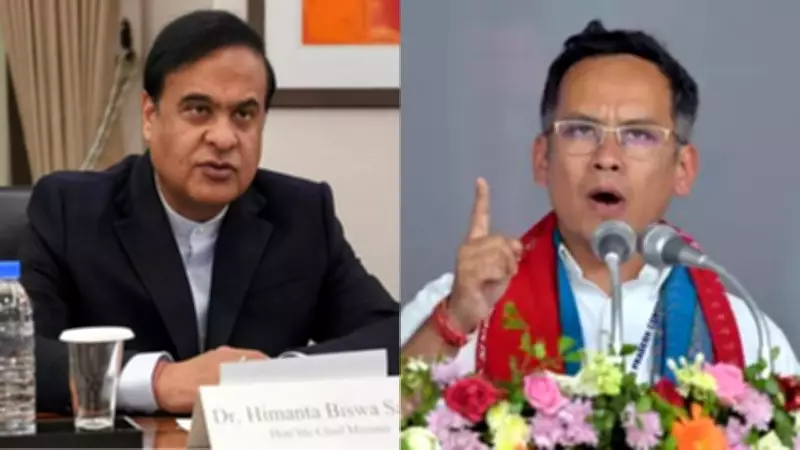
Assam Cabinet Refers Congress MP Gogoi's Pakistan Links Case to MHA Citing National Security
The Assam cabinet, in a significant move on Saturday, decided to refer the case involving Congress MP Gaurav Gogoi's alleged Pakistan connections to the Ministry of Home Affairs (MHA). Chief Minister Himanta Biswa Sarma emphasized that the matter pertains to national security and has surpassed the investigative capabilities of state agencies.
Cabinet Decision and SIT Limitations
Briefing reporters after chairing a cabinet meeting in Guwahati, Chief Minister Sarma stated that the cabinet unanimously resolved to hand over the investigation to the central government. The Special Investigation Team (SIT), constituted by the Assam government, has reached its operational limits, necessitating the involvement of central agencies to advance the probe.
"The Assam government had constituted an SIT to inquire into the alleged anti-India conspiracy involving a Pakistani national in connivance with a British citizen and a Member of Parliament. Considering the gravity of the situation, it was decided to transfer the case to the MHA," Sarma explained.

He further clarified that the SIT report and the registered case documents will be forwarded to the MHA, which can then deploy any of its investigating agencies, such as the NIA, IB, or CBI, to take the investigation forward. The cabinet viewed this as a national security issue rather than a personal matter, involving multiple international players.
Allegations and Investigative Hurdles
The chief minister elaborated on the allegations, claiming that a Pakistan-based firm had employed Gogoi's British wife, Elizabeth Colburn, and later transferred her to India, with her salary allegedly paid by Pakistani national Ali Tauqeer Sheikh. Sarma asserted that the SIT had gathered sensitive material but faced constraints in proceeding further without central assistance.
"Sensitive information and materials have been obtained by the SIT from various sources, but help from Interpol and access to sensitive data from the central government and Parliament are required," Sarma noted. He added that the state probe has only uncovered about 10% of the information, with 90% yet to be discovered.
Without explicitly naming Gogoi, Sarma referenced an MP from Assam who visited Pakistan during his father's tenure as chief minister, alleging that the visit was not disclosed to the central government and that the MP went off social media during the stay. He also mentioned evidence of travel to Pakistan between 2012 and 2016 but admitted that Assam Police could not collect telephonic evidence due to the involvement of foreign nationals.
Political Context and Gogoi's Response
Sarma maintained that the investigation is driven by national security concerns, with political implications being secondary. "This investigation is for the sake of national security. Its impact on politics is secondary," he stated, highlighting the central roles of a Pakistani national and a British citizen in the case.
In response, Gaurav Gogoi has vehemently denied all allegations, dismissing Sarma's remarks as "ridiculous, baseless, insane, and nonsense." He accused the chief minister of acting like an "IT cell troll" without factual basis and suggested that the accusations are politically motivated, aimed at diverting attention from allegations against Sarma himself.
Gogoi retorted, "If my wife is an ISI agent of Pakistan, then I am a R&AW agent of India," underscoring his rejection of the claims.
Future Steps and Transparency
The SIT submitted its report to Chief Minister Sarma, who also holds the Home portfolio, on September 10. After several delays, Sarma announced that non-confidential information from the report will be disclosed at a press conference on February 8, with cabinet authorization. He did not rule out exploring the "angle of religious conversion" but declined to provide specifics at this stage.
This development marks a critical juncture in the case, as it transitions from state-level scrutiny to a broader, central investigation, underscoring the complex interplay between national security, politics, and international relations.






