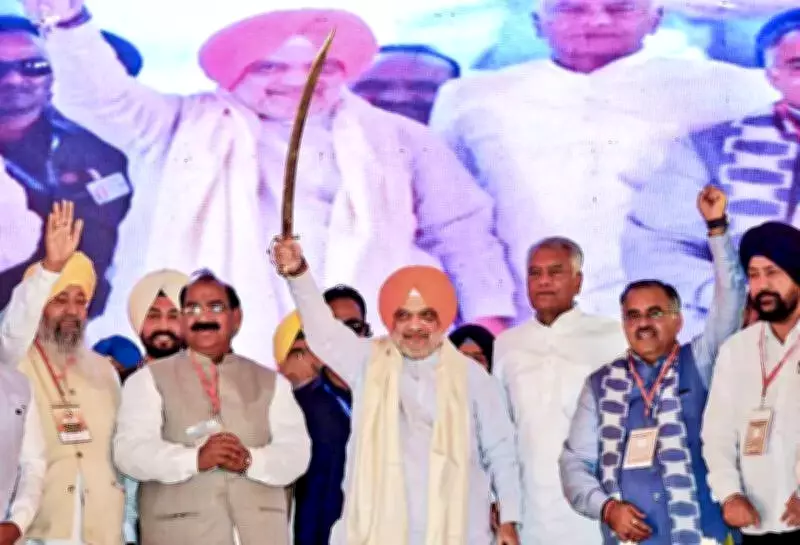
Amit Shah Tackles Farmer Concerns at Badlav Rally in Moga
In a significant political outreach, Union Home Minister Amit Shah presided over the "Badlav rally" in Kili Chahalan, Moga, with a clear focus on easing tensions with the farming community. This move comes amid ongoing concerns from farmers initially sparked by farm laws and recently intensified by the inclusion of agriculture in the proposed Indo-US trade deal.
Countering the Anti-Farmer Narrative
Shah directly addressed what he called a false narrative portraying the Bharatiya Janata Party (BJP) as anti-farmer, specifically targeting Congress leader Rahul Gandhi. "Whatever BJP under PM Modi has done for farmers has not gone down well with the Congress, mainly Rahul Gandhi, who is spreading lies to keep the community against us," Shah stated emphatically. He dismissed claims that farmers would be destroyed by the trade deal, asserting that "the reality is otherwise."
The home minister emphasized that previous Congress regimes could not match the BJP's efforts to uplift farming communities. With farmers forming a massive electoral bloc in Punjab, the rally represented a strategic attempt to bridge gaps created by repeated protests and address prevailing anger within the agricultural sector.

Highlighting Fiscal Achievements in Agriculture
Budget Increases and Direct BenefitsShah presented compelling fiscal data to support his claims, noting that the agriculture budget has risen dramatically from ₹22,000 crore under Congress governments to ₹1,40,000 crore under the BJP administration. He credited the current government with implementing crucial farmer-friendly policies including:
- MSP procurement fixed at 50% profit over production costs
- Initiation of the PM Kisan scheme, depositing ₹6,000 annually into farmer accounts
- Promotion of organic farming to decrease fertilizer dependence and save input costs
"The BJP is decreasing fertiliser dependence by promoting organic farming to save input costs," Shah explained, positioning this as both an economic and environmental benefit for farmers.
Regional Comparisons and Political Positioning
Shah utilized the rally platform to draw pointed comparisons between Punjab and neighboring Haryana. By highlighting Haryana's successful MSP implementation, the BJP leadership aimed to spotlight what they characterized as failures of the local Aam Aadmi Party (AAP) administration in Punjab.
"The AAP government in Punjab has failed to purchase various crops at MSP as promised," Shah stated, contrasting this with Haryana's performance. This geographical comparison served to position the central government as the primary guarantor of crop security and agricultural stability.
Building a Pro-Farmer Foundation
Earlier in the event, Punjab BJP president Sunil Jakhar laid the groundwork for this pro-farmer narrative. Acknowledging the prevailing sentiment among farmers, Jakhar stated, "The BJP has done a lot, but as the saying goes, 'Yeh Dil Maange More,' we need to do more."
Jakhar advocated for supporting farmers in precarious conditions and establishing allied industries to bolster the agricultural sector, suggesting a comprehensive approach beyond immediate financial benefits.
A Fiscal Harvest Presentation
Throughout his address, Shah pivoted discussions toward direct financial benefits, contrasting the current administration's spending with historical data. By citing the six-fold increase in the agriculture budget, the party sought to present what they called a "balance sheet of pro-farmer governance" to a sometimes skeptical audience.
The rally represented a calculated effort to change perceptions ahead of crucial electoral contests, with the farming community's support remaining pivotal in Punjab's political landscape. As agricultural concerns continue to shape political discourse, such outreach events signal the BJP's recognition of farmers' enduring influence on electoral outcomes.