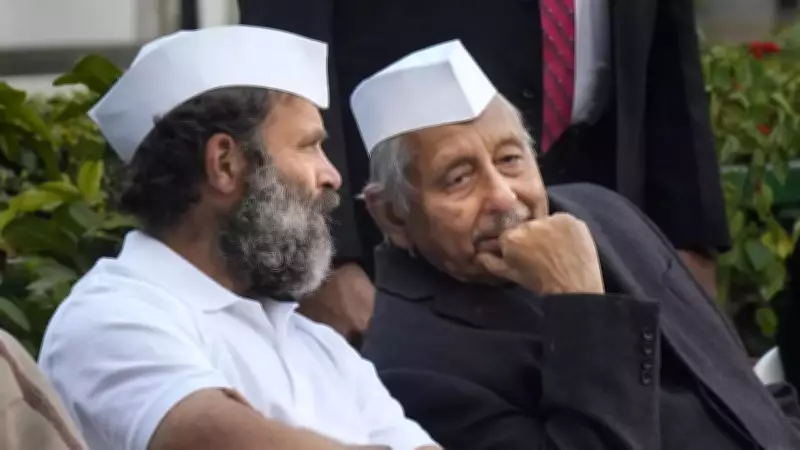
Mani Shankar Aiyar's Provocative 'Rahulian' Remark Ignites Ideological Firestorm in Congress
When veteran Congress leader Mani Shankar Aiyar publicly declared himself to be "a Gandhian, Nehruvian, Rajivian but not a Rahulian," it initially appeared as another characteristic provocation from the outspoken politician. However, this statement, delivered during a critical period when the Congress party is striving to project discipline and unity ahead of key assembly elections, has rapidly evolved into a substantial debate concerning ideology, authority, and dissent within India's grand old political institution.
Congress Distances Itself as Analysis Reveals Deeper Ideological Shifts
The Congress party moved swiftly to distance itself from Aiyar's controversial remarks, explicitly stating that the veteran leader "has no association with the party." This decisive action prompts a crucial question: Was Aiyar merely indulging his well-documented taste for rhetorical rebellion, or was he highlighting a genuine transformation in how the Congress party functions under Rahul Gandhi's influence?
Political analyst and Congress chronicler Rasheed Kidwai believes Aiyar's claim contains "a grain of truth," though not necessarily in the manner the former minister intends. According to Kidwai, the Congress has undergone a significant ideological evolution that explains the context of Aiyar's criticism.

From Nehruvian Legacy to Civil Society Orientation
"What Mani Shankar Aiyar is saying has a grain of truth because Congress has moved from a Nehruvian way of looking at things, or so to say the Nehruvian ideology, to a civil society orientation," Kidwai explains. This transition represents the third distinct ideological phase in the party's modern history.
The analyst outlines this evolution through three clear stages:
- The original Nehruvian thinking that dominated Congress ideology for decades
- The economic reform period during the tenures of Prime Ministers Narasimha Rao and Manmohan Singh
- The current shift toward civil society thinking under Rahul Gandhi's influence
This ideological transition helps explain why Aiyar's attack on "Rahulian" politics resonates in certain political circles. Unlike previous eras where ideology shaped policy or economic pragmatism dominated decision-making, today's Congress under Rahul Gandhi does not operate within a rigid ideological framework in the classical sense.
The Growing Influence of Civil Society and 'Jai Jagat' Group
Kidwai has previously documented what he describes as an expanding civil society imprint within the Congress party, particularly surrounding Rahul Gandhi. This school of thought prioritizes moral argument, decentralized activism, and individual agency over traditional state-led or party-led political action.
This orientation, which gained visibility during the Sonia Gandhi-led UPA years through bodies like the National Advisory Council, has now "almost taken over the party organisation under Rahul Gandhi," according to Kidwai's analysis. Civil society protagonists, often associated with the so-called "Jai Jagat" group, reportedly enjoy proximity to Rahul Gandhi and occupy influential organizational roles.
Their emphasis on plain living, minimalism, and symbolic politics has become part of the Congress's contemporary aesthetic. However, as Kidwai notes, this culture creates tension with traditional Congress leaders who ascended through party ranks and understand politics as negotiation, organization, and power management rather than moral signaling.
Aiyar's Isolation and the 'Uncle Syndrome' Within Congress
While Aiyar positions himself as a custodian of Congress ideology, Kidwai is unequivocal about his diminished standing within the party. "Mani Shankar Aiyar is totally isolated. There is no group, there is no leader in Tamil Nadu or outside who would be subscribing to Mr. Mani Shankar Aiyar," the analyst states bluntly.

Kidwai contrasts Aiyar's isolation with other Congress leaders like Shashi Tharoor and Manish Tiwari, who have disagreed with Rahul Gandhi but retain organizational traction. Aiyar's paradox, according to Kidwai, lies in his political identity: "Mani Shankar Aiyar's claim to fame was his loyalty towards Rajiv Gandhi. Now there is a bit of a paradox that he is confronting Rajiv Gandhi's son."
The analyst also addresses what he terms the "uncle syndrome" within the Congress party. "Rahul Gandhi has not got a clean slate. He has three, four uncles watching over him," Kidwai observes. "Mani Shankar Aiyar is one uncle who says - you are not doing things right."
Why Congress Finally Drew the Line Against Aiyar
Aiyar has repeatedly embarrassed the Congress with controversial remarks, including his "chaiwala" and "neech aadmi" comments about Prime Minister Narendra Modi. His recent outburst contained nothing substantially new, raising questions about why the Congress chose this moment to explicitly disassociate itself from him.
Kidwai attributes this timing to shifting internal equations. "There was a perception that Mr. Sam Pitroda and Mr. Mani Shankar Aiyar are close to the family," he explains. This perceived proximity once provided insulation against disciplinary action.
However, that protective cover has now vanished. "Now people know that he does not have the backing of the family. So Mr. Aiyar had a false kind of cover ... now that stands exposed," Kidwai argues. By contrast, he notes that Sam Pitroda remains protected because "Mr. Sam Pitroda is still in good books of Rahul Gandhi."
The Spin Doctor Without a Party: Aiyar's Diminished Relevance
Kidwai traces Aiyar's instinct for provocation to his background as what he describes as an "original spin doctor" before the social media and internet boom. Aiyar's diplomatic career and role as a key Rajiv Gandhi aide honed this instinct, which now operates without institutional relevance.
"He's trying to seek attention of Sonia Gandhi and Rahul and Priyanka ... and he's not getting it," Kidwai observes. The analyst believes Aiyar's use of the term "Rahulian" represents part of this attention-seeking strategy rather than a serious ideological intervention.
Valid Concerns Amid Personal Grievances
While dismissive of Aiyar's influence, Kidwai does not entirely reject his underlying diagnosis. "There is a discomfort, which is not evident," he says, referring to unease within the Congress over Rahul Gandhi's reliance on civil society inputs rather than organizational consensus.
He points to campaign slogans and movements like "chowkidar chor hai" and "vote chori" as examples of strategies that did not emerge from internal party deliberation. "None of these things have come from the Congress organisation," Kidwai notes.
Yet, unlike Shashi Tharoor who secured 11-12 percent of votes in the 2023 Congress presidential election, Aiyar commands no following. "Mani Shankar Aiyar will get zero," Kidwai states bluntly.
The Legacy of a Political Term and a Veteran's Isolation
For now, Aiyar has coined the new term "Rahulian" which the Congress's political opponents may attempt to embed in public memory. Its originator, however, may fade further into irrelevance within the party he once helped shape.
Aiyar may have identified something real—an ideological shift from structured doctrine to civil society politics. However, in doing so, Kidwai argues that he has personalized a transformation that is larger than Rahul Gandhi and predates Aiyar's own grievances.
Ultimately, Aiyar's rebellion may reveal less about the Congress's future direction and more about one veteran's inability to accept that the party he once significantly influenced has evolved and moved forward without him. The ideological debate he has ignited, however, continues to resonate through India's political landscape as the Congress navigates its identity in a changing political environment.