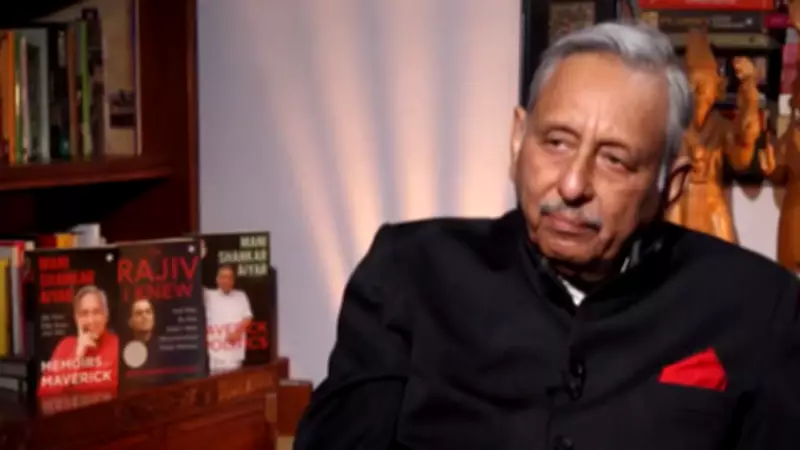
Veteran Leader Mani Shankar Aiyar Issues Stark Warning to Congress Leadership
Veteran Congress leader Mani Shankar Aiyar has launched a fresh critique against his party's current leadership, delivering a historical analysis that suggests the Indian National Congress has always flourished through internal dissent and suffered catastrophic consequences whenever it attempted to suppress disagreement.
Historical Perspective: Dissent as Congress's Defining Strength
In a detailed video released on his YouTube channel titled 'No Space for Dissent in Today's Congress?', Aiyar meticulously traced ideological conflicts, leadership rivalries, and rebellions stretching back to the party's founding in 1885. He presented a compelling argument that disagreement, rather than conformity, has been the Congress party's defining strength throughout its long history.
"There was just one time when a complete ban was placed on any kind of dissidents. That was during Indira Gandhi's Emergency," Aiyar stated emphatically. According to his analysis, the consequences of silencing dissent during that period were devastating for the party. "The Congress not only lost," he explained, "Indira Gandhi lost her Rae Bareli seat and Sanjay Gandhi lost his Amethi seat. That is what happens if you crush dissidents in the Congress party."

Early Examples of Internal Disagreement
Aiyar argued that internal disagreement has existed within Congress almost from its very inception and was never treated as an aberration. He cited the selection of Badruddin Tyabji as Congress president in 1888 and the backlash he faced from sections of the Muslim elite, describing this as one of the earliest recorded episodes of dissent within the party.
The veteran leader went on to recount significant ideological clashes between moderates and extremists in the early 20th century, particularly highlighting the split between Bal Gangadhar Tilak, Lala Lajpat Rai, and Bipin Chandra Pal on one side, and leaders like Gopal Krishna Gokhale and M.G. Ranade on the other. This ideological conflict culminated in the historic Surat split of 1907.
"The real strength of the Congress has been in the variety of opinion which the Congress has always accommodated," Aiyar asserted. He noted that despite sharp disagreements, figures like Tilak eventually became Congress president, while Mahatma Gandhi openly acknowledged Gokhale as his political guru, underlining the party's historical ability to absorb contradictions rather than eliminate them.
Subhas Chandra Bose and the Tradition of Tolerance
Drawing pointed historical parallels, Aiyar referenced 1929 when Subhas Chandra Bose sarcastically remarked that the Congress was being run by "the Father, the Son and the Holy Ghost." "Nobody expelled Subhas Chandra Bose for what he had said," Aiyar emphasized. He described how Bose later walked out of the Congress after fundamental disagreements with Mahatma Gandhi over non-violence, forming the Forward Bloc, but was never formally expelled from the party.
"He walked out of the Congress. He was not expelled," Aiyar reiterated, highlighting this as evidence of the party's traditional tolerance for dissent.
Aiyar also recalled intense disagreements between Jawaharlal Nehru and his father Motilal Nehru, noting that "it became impossible to have dinner in Anand Bhavan because the father and son were quarrelling so much among each other." He presented this as a prime example of how the Congress historically managed internal conflict.
Indira Gandhi's Break from Tradition
Aiyar argued that Indira Gandhi marked a decisive break from this long-standing tradition of accommodating dissent. While disagreements with the Congress "Syndicate" were initially accommodated, he said, her decision to split the party and later impose the Emergency represented what he called a "fatal intolerance of dissent."

"She broke the party only because there were dissidents," Aiyar stated, adding that the Emergency was "the only way in which she could remain prime minister." The electoral verdict, he argued, came swiftly and decisively, with both Indira Gandhi and her son Sanjay losing their parliamentary seats in the subsequent election.
Challenging Current Leadership
Turning to contemporary politics, Aiyar quoted two sentences Rajiv Gandhi uttered in the Lok Sabha on May 5, 1989: "Only a secular Bharat can survive. And if India is not secular, then perhaps it does not deserve to survive."
Transforming those words into a direct challenge to current party leadership, Aiyar declared: "I say to the Congress Party high command who have kept me out of the Working Committee, which now has 60 members, do you have the courage to repeat the words in the mouth of the son of Rajiv Gandhi?"
Issuing a stern warning to the current establishment, Aiyar stated: "If, therefore, the current establishment cannot stand a dissident, then I'm afraid it is the doom of the Congress." He added emphatically: "The Congress lives because of dissidents. The Congress grows because there are many opinions."
His final message was blunt and uncompromising: "If we do not have the courage to answer the dissident in polite but firm language, then we do not deserve to rule."
Current Context and Party Response
The video comes amid ongoing controversy over Aiyar's recent remarks about party leadership and his praise for Kerala Chief Minister. The Congress has officially distanced itself from Aiyar's statements, with party spokesperson Pawan Khera clarifying on social media platform X that Aiyar "has had no connection whatsoever with the Congress for the past few years. He speaks and writes purely in his personal capacity."
Aiyar's comprehensive historical analysis presents a fundamental challenge to the Congress party's current approach to internal disagreement, suggesting that the party's future survival may depend on returning to its historical tradition of accommodating diverse opinions rather than suppressing dissent.