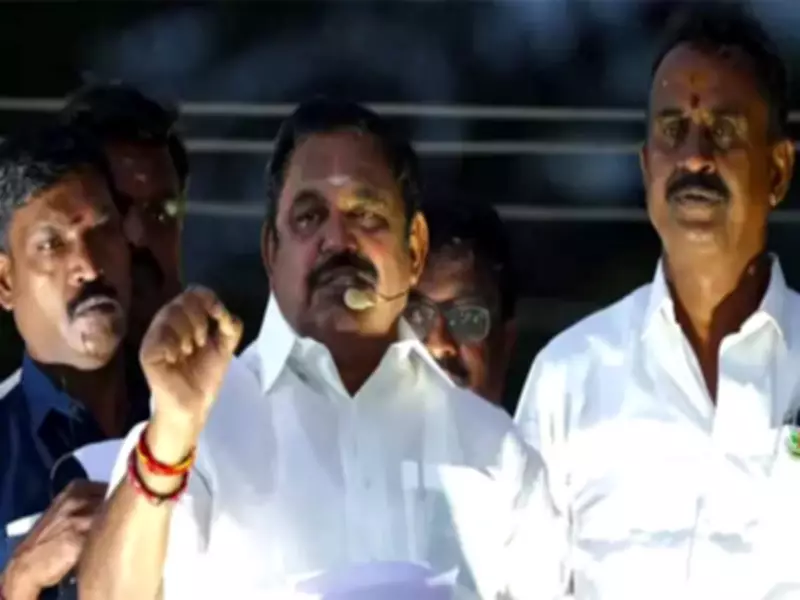
AIADMK Leader Palaniswami Launches Scathing Attack on DMK, Calling It Congress 'Slave'
In a fiery political confrontation, AIADMK general secretary Edappadi K Palaniswami has launched a blistering verbal assault on Tamil Nadu's ruling DMK party, branding it as a "slave" of its ally, the Congress. The explosive remarks were delivered during a public rally in Perunthurai on Sunday, marking a significant escalation in the ongoing political warfare between the state's major parties.
Political Retaliation Following Stalin's Provocative Comparison
Palaniswami's incendiary comments came as a direct response to Tamil Nadu Chief Minister MK Stalin's provocative statement from the previous day, where he predicted that the AIADMK leader would "meet the same fate" as outgoing Bihar Chief Minister Nitish Kumar at the hands of the BJP. This comparison has ignited a fresh wave of political hostilities, with both sides trading sharp barbs in what appears to be a pre-election positioning strategy.
The AIADMK and JD(U), both allies of the BJP which leads the central government, find themselves at the center of this political storm. Palaniswami, who previously served as Tamil Nadu's chief minister, did not hold back in his criticism of the DMK-Congress relationship, painting a picture of subservience and intimidation.

Historical Allegations of Congress Intimidation Tactics
During his rally address, Palaniswami recounted what he described as a pattern of Congress dominance over the DMK, reaching back to the era of DMK patriarch M. Karunanidhi. "People have not forgotten that even when Karunanidhi was alive, the Congress intimidated the DMK, reduced it to a slave and forged an alliance with it," he alleged, suggesting that this dynamic was achieved through coercive tactics including raids during sensitive seat-sharing negotiations.
The AIADMK leader specifically referenced recent tensions between the Congress and DMK, highlighting their 20-day war of words over seat-sharing arrangements for upcoming Assembly polls. According to Palaniswami, this conflict ultimately resulted in the Congress "intimidating" the DMK to secure 28 seats, further reinforcing his narrative of DMK subordination.
AIADMK's Positioning as an Independent Political Force
In stark contrast to his portrayal of the DMK, Palaniswami presented the AIADMK as an "independent party" that made the strategic decision to contest the 2024 Lok Sabha elections autonomously. This declaration serves to emphasize what he views as a fundamental difference in political philosophy and operational independence between the two rival parties.
The former chief minister went on to describe the AIADMK's current alliance structure as "robust, transparent and cordial," positioning it as a superior alternative to what he characterized as the DMK-led coalition's compromised dynamics. This assessment comes following the AIADMK's reunion with the BJP in April of the previous year, a move that has reshaped Tamil Nadu's political landscape.
Context of the Nitish Kumar Comparison and Broader Implications
Stalin's comparison between Palaniswami and Nitish Kumar carries significant weight, referring to the Bihar chief minister's recent decision to file a Rajya Sabha nomination after nearly two decades of state leadership. This development occurred mere months after Kumar successfully steered the JD(U)-BJP alliance to a landslide victory in Bihar, with opposition parties describing the move as "orchestrated" by the BJP.
The political exchange between Palaniswami and Stalin reveals several critical dimensions of contemporary Indian politics:

- The ongoing realignment of political alliances at both state and national levels
- The strategic use of historical narratives to discredit opponents
- The intensifying competition ahead of crucial electoral contests
- The complex dynamics between regional parties and their national allies
As Tamil Nadu's political temperature continues to rise, these exchanges between the AIADMK and DMK leadership signal what promises to be a fiercely contested battle for political supremacy in the state. The characterization of the DMK as a Congress "slave" represents one of the most direct attacks on the ruling party's autonomy and decision-making capacity, setting the stage for further political confrontations in the coming months.