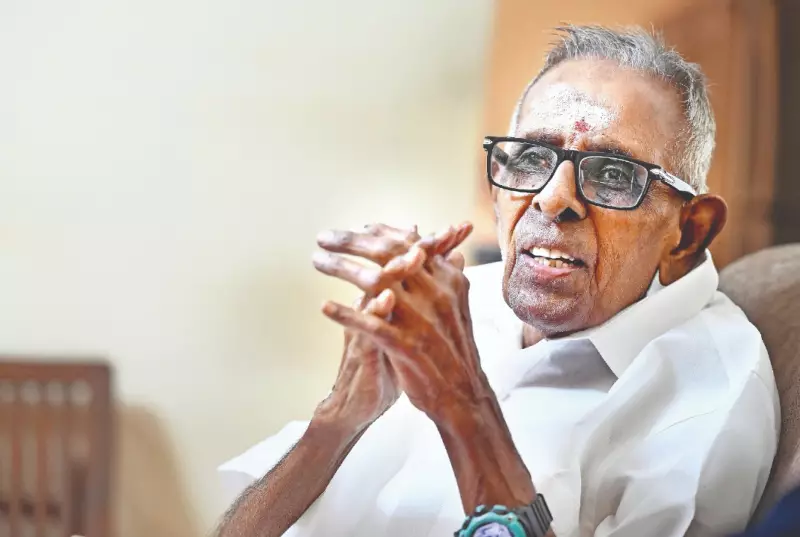
At the remarkable age of 99, Laxmikanthan Bharathi stands as a living monument to India's freedom struggle, likely the oldest surviving freedom fighter and Gandhian in the state. Honoured in his centenary year by The American College in Madurai, the former IAS officer shared profound memories of the 1940s independence movement in an exclusive interview, offering a rare, personal window into a defining era.
A Legacy Forged in Sacrifice: A Family of Freedom Fighters
Bharathi's commitment to the nation's cause was a family inheritance. His father, Krishnaswami Bharathi, was a Madurai advocate who faced imprisonment during the freedom struggle in 1930, 1932, and 1941, spending nearly five years behind bars. He later served as a Member of Parliament and was a distinguished member of the Constituent Assembly of India that drafted the nation's Constitution.
His mother, Lakshmi Bharati, was jailed twice for her activism and served as an MLA for two terms. The spirit of resistance permeated the entire household. Bharathi recalls that he and his sister were both arrested during the historic Quit India Movement of 1942 and imprisoned. The entire family was detained at various times in the freedom struggle, a testament to their unwavering dedication.

Childhood in the Shadow of the Struggle
Bharathi's earliest memories are steeped in the atmosphere of the fight for independence. He vividly remembers visiting his father in Vellore jail as a young child, trying to touch him through the bars, a sight that moved his father to tears. Prominent Congress volunteers, including Rajaji and Kamaraj, were frequent visitors to their home for lengthy discussions.
Though I did not understand the concept of freedom, the whole atmosphere was charged with nationalism, he reflects. He wore khadi from the age of four and helped volunteers make small Congress flags at his house. These flags would be planted at Madurai street corners at night, only to be removed by police in the morning, met with defiant shouts of ‘Gandhiji ki jai’ from the public. That kind of emotion will never be seen in India again, he states with poignant certainty.
From Prisoner to Collector: An Eventful Journey
His activist spirit continued into college, where he served as secretary of the students’ federation at American College, Madurai, organizing processions with slogans like ‘We demand freedom first’. His arrest during this period was particularly brutal. The police chained his hands and paraded him through the streets from Madurai jail to the collector's office, a distance of about 8km, to terrorise people. His mother wept upon seeing him in chains. He was sentenced to six months’ imprisonment.
In a profound twist of fate, after Independence, Bharathi joined the Indian Administrative Service (IAS). Years later, he walked up the very steps of the collector's office where he was once paraded as a prisoner, this time to assume office as the Collector of Madurai. It was an intensely emotional moment, symbolizing the journey from colonial subject to empowered administrator.
Reflections on Gandhi's Unfulfilled Vision and Modern Politics
When asked if Independence realized the Gandhian ideal, Bharathi offers a sobering assessment. He explains that the fight was for a transformative government, not merely a transfer of power. Gandhiji wanted participatory, not just representative, democracy, envisioning every village as an independent republic. His core tenets included abolishing liquor shops, an economy based on handmade goods, mother tongue as the medium of instruction, and the abolition of caste.
None of the Gandhian ideas are found in India now, he concludes with regret. On contemporary Tamil Nadu politics, the former communist party member observes a stark absence of ideology. What is the ideological difference between DMK and AIADMK? he questions, noting the lack of a united opposition and emphasizing that genuine ideological differences are necessary for principled political contestation.

The life of Laxmikanthan Bharathi is not just a chronicle of the past but a mirror reflecting the gaps between the freedom fighters' dreams and contemporary India's realities.