The 2026 assembly elections are delivering a political jolt as results take clearer shape on Monday. From a cinematic upheaval in Tamil Nadu to a decisive saffron surge in West Bengal, the verdict is throwing up headline-grabbing shocks and unsettling long-held assumptions about who holds power and how.
Key Takeaways from the 2026 Assembly Election Results
1. Thalapathy Vijay's Blockbuster Debut
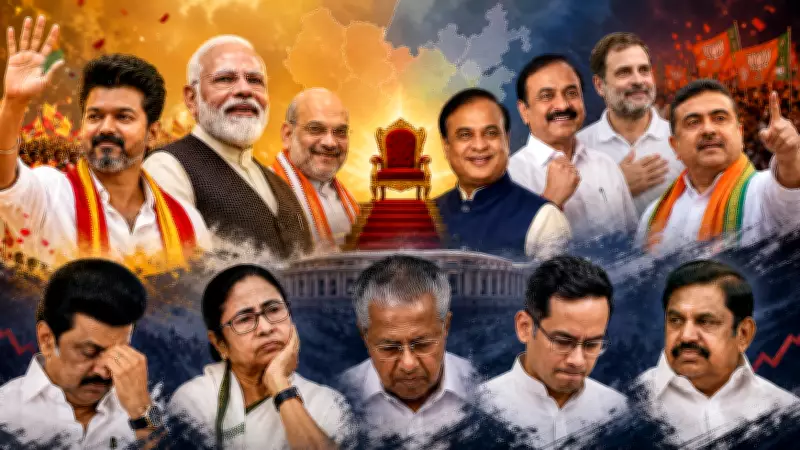
Vijay's Tamilaga Vettri Kazhagam, leading in over 118 seats, has upended the decades-old DMK–AIADMK dominance that defined Tamil Nadu politics for over 50 years. This is not just a strong debut; it marks a structural shift, with voters showing a willingness to move beyond legacy parties. The state now appears headed toward a multi-polar contest, where no single formation can take voter loyalty for granted.
2. BJP Breaches Bengal's Fortress
For the first time, the Bharatiya Janata Party has crossed the majority mark in West Bengal, ending Mamata Banerjee’s long tenure. This is more than a state-level victory; it represents a strategic breakthrough in eastern India. After years of falling short, the BJP has managed to convert organisational expansion and narrative recalibration into a decisive mandate.

3. Kerala Returns to Its Rotation Cycle
The Congress-led UDF, under VD Satheesan, is set to form the government, halting the Left’s attempt at a third consecutive term. The result reinforces Kerala’s long-standing pattern of alternating power, suggesting that voters continue to prefer periodic change over continuity, even when incumbents deliver on governance.
4. Assam Shows Pro-Incumbency Can Work
Himanta Biswa Sarma has led the BJP to a third straight win, underlining a shift in voter behaviour. Instead of the usual anti-incumbency, the results suggest that delivery on infrastructure, welfare schemes and administrative visibility can generate pro-incumbency, turning governance into a political asset rather than a liability.
5. DMK Bears the Brunt of TVK Surge
The ruling Dravida Munnetra Kazhagam appears to be the biggest casualty of the TVK surge, losing ground in several key regions, including urban pockets. The verdict reflects a mix of anti-incumbency, fatigue with dynastic politics, and the appeal of a fresh alternative, all of which combined to create space for Vijay’s rise.
6. BJP's Best-Ever Performance in Kerala
Even where it is not in contention for power, the BJP has made incremental gains in the south. In Kerala, it is on course for its best-ever performance with 3 seats. It had recently delivered a victory in Thiruvananthapuram civic polls. These gains, though modest, point to a long-term strategy of gradual expansion in regions where the party has traditionally struggled.
7. AIADMK Survives the Disruption
Despite the scale of the TVK surge, Edappadi K Palaniswami has managed to retain a core base, particularly in the western belt. While the party is no longer the primary pole it once was, its survival ensures that Tamil Nadu’s politics will remain competitive, with multiple players shaping future contests.
8. Congress Gets a Strategic Breather
With a clear win in Kerala and signs of resilience in parts of Assam, the Congress has regained some political ground. While challenges remain, the results provide the party with organisational momentum and reinforce its role as the principal opposition force at the national level.
9. A Weaker Opposition
The 2026 assembly election results have significantly weakened the opposition. In key states, prominent regional leaders who once anchored anti-BJP politics have either lost ground or are on the verge of losing power. The setback to Mamata Banerjee in West Bengal and the slide of MK Stalin in Tamil Nadu removes two of the most influential regional counterweights to the BJP. In Kerala, the exit of Pinarayi Vijayan further narrows the opposition’s governing footprint.
10. Cascading Effect on INDIA Bloc
This churn has a cascading effect. The INDIA bloc, already an uneasy coalition of regional forces, now faces a leadership vacuum as its strongest state-level pillars weaken or disappear. At the same time, the Congress gains from a potential win in Kerala, which also makes its power stronger within the opposition bloc.

Follow the latest election results 2026, live updates, winner lists, constituency-wise results, party-wise trends and full coverage for Tamil Nadu, West Bengal, Kerala, Assam and Puducherry on Times of India.