

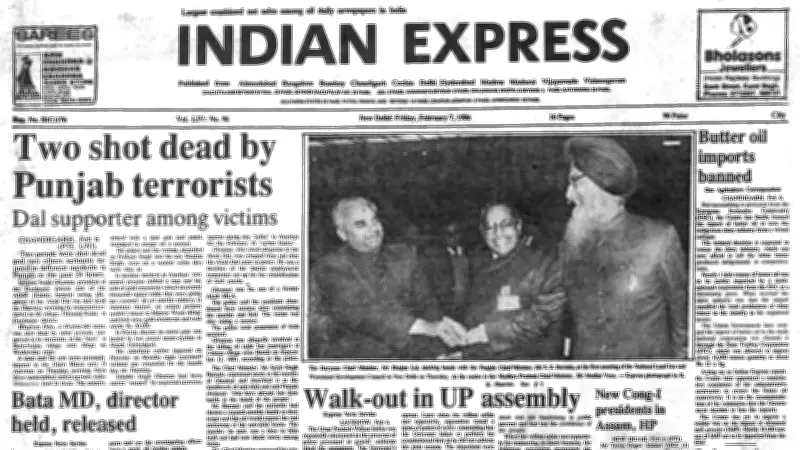
February 7, 1986: A Day of Economic Protection, Technological Advancements, and Political Turmoil
Forty years ago, on February 7, 1986, India witnessed a pivotal moment as the Centre made a decisive move to safeguard its domestic dairy industry. Resisting significant pressure from the European Economic Community (EEC), the government imposed a ban on the import of butter oil. This long-awaited decision was aimed at rescuing the indigenous dairy sector from foreign competition, with nearly 1 lakh tonnes of butter oil slated for import by a multinational corporation from the EEC. The ban marked a critical step in protecting local farmers and producers, highlighting the government's commitment to economic self-reliance amid global trade tensions.
War on Fog: Airports to Get Cutting-Edge Landing Systems
In a parallel development, the Indian aviation sector prepared for a major upgrade to combat fog-related disruptions. Before the onset of the next winter, 11 airports across the country were set to be equipped with the latest Instrument Landing System (ILS). This multi-crore project involved installing new electronic gadgets in control towers and on runways, enabling flight landings even in the poorest visibility conditions. The airports included Delhi, Agartala, Jaipur, Patna, Jammu, Imphal, Amritsar, Bhopal, Kanpur, Mohanbari (Dibrugarh), and Varanasi. Work progressed on a war-footing, signaling a proactive approach to enhancing air travel safety and efficiency.
Political Unrest: Uttar Pradesh Assembly Sees Walkout Over Police Presence
The political landscape in Uttar Pradesh was tense as the Vidhan Sabha faced repeated adjournments. The presence of police personnel in guard uniforms irked the Opposition, leading to slogan shouting and protests during the Governor's address to the joint session of the legislative assembly. The address was cut short, and Opposition leaders staged a walkout. In a signed statement, they explained that their protest was against the anti-people policies of the state government, accusing it of using repressive measures to suppress public grievances. This incident underscored the deepening political divisions and civil unrest in the region.

Violence in Punjab: Two Shot Dead in Separate Incidents
In Punjab, violence escalated with two people shot dead and two others seriously injured in different incidents over the past 24 hours. Jatinder Singh Ghuman, president of the Gurdaspur district unit of the All-India Sikh Students’ Federation (Khalsa faction), affiliated with the Shiromani Akali Dal, was killed by suspected terrorists in his village, Ghuman Kalan. Additionally, Bhagwan Dass, a 65-year-old religious leader, was shot dead at his "dera" in Buttar Kalan village near Moga, also by suspected terrorists. These events highlighted the ongoing security challenges and militant activities in the state during that period.
This article is based on the front page of The Indian Express published on February 7, 1986, capturing key national events from that day.






