

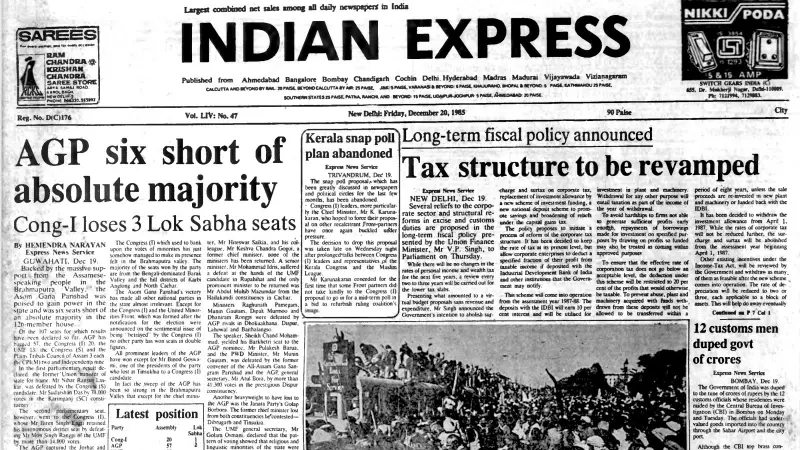
December 20, 1985, stands as a remarkable date in India's modern history, witnessing pivotal developments across politics, economics, and foreign policy. From a seismic shift in Assam's political landscape to significant fiscal announcements and a groundbreaking diplomatic move, the day captured a nation in transition.
AGP Poised to Form Government in Assam
In a historic verdict, the Asom Gana Parishad (AGP), riding on a wave of support from the Assamese-speaking populace, was on the cusp of securing power in the state of Assam. The election results declared by December 20 revealed that the AGP had won 57 out of the 107 seats for which outcomes were announced.
This put the party just six seats short of an absolute majority in the 126-member legislative assembly. The Congress (I) trailed significantly with 20 seats, while the United Minorities Front (UMF) secured 13. This result marked a dramatic change in the state's politics, underscoring the AGP's emergence as a dominant regional force.

Long-Term Fiscal Policy Unveils Tax System Overhaul
On the economic front, Union Finance Minister V. P. Singh presented a long-term fiscal policy to Parliament, proposing substantial reforms. The policy outlined several reliefs for the corporate sector and suggested structural changes in excise and customs duties to streamline the taxation framework.
In a move aimed at providing stability to individual taxpayers, the government announced that rates for personal income and wealth tax would remain unchanged for the next five years. However, it committed to a review every two to three years specifically for the lower tax slabs, indicating a focus on progressive taxation.
A Landmark Step Towards Subcontinental Peace
In a development that captured international attention, India and Pakistan agreed to sign a peace and friendship treaty with the ambitious aim of abolishing war from the subcontinent. This landmark decision was reached during a meeting that lasted a few hours between Prime Minister Rajiv Gandhi and Pakistan President General Zia-ul-Haq.
This agreement represented a significant, though ultimately short-lived, thaw in the often-fraught relations between the two neighbouring nations, highlighting a moment of diplomatic optimism.
BJP's Internal Rift Over Land Scandal Probe
Meanwhile, in domestic political intrigue, the credibility of the opposition faced a jolt due to an internal expose within the Bharatiya Janata Party (BJP). Ram Naik, the president of the BJP's Bombay unit, had brought to light the so-called Dindoshi land "scandal."
The immediate acceptance of his demand for an investigation backfired, causing resentment among his own party members. This was because the land deal in question was part of a settlement finalized in 1979 by the then Progressive Democratic Front government with the Dindoshaw Trust, making the probe politically complicated for the opposition bloc.
These events from December 20, 1985, collectively paint a picture of a dynamic India—where regional aspirations were reshaping state politics, the economy was being cautiously reformed, and diplomacy offered glimpses of a peaceful future, even as political controversies simmered.






