December 17, 1985, stands as a significant date in India's modern history, marking pivotal developments across politics, interstate relations, and sports. From a landmark democratic exercise in Assam to a firm stance on a contentious water dispute and a cricketing legend's pursuit of a milestone, the day encapsulated the nation's diverse narrative.
Historic Voter Participation in Assam Elections
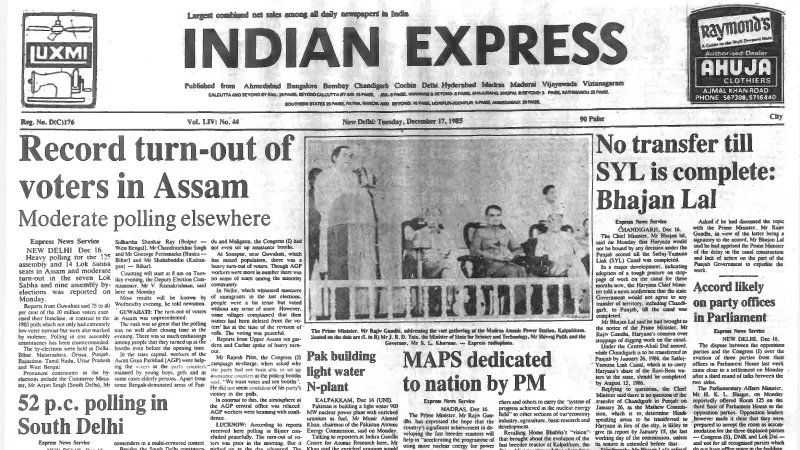
Reports from Guwahati on this day highlighted an extraordinary display of democratic spirit in Assam. An estimated 75 to 80 percent of the state's 10 million eligible voters cast their ballots for the 125 assembly and 14 Lok Sabha seats. This heavy polling presented a stark and positive contrast to the state's previous electoral exercise in 1983, which was not only marred by an extremely low voter turnout but also widespread violence. The peaceful and enthusiastic participation in 1985 was seen as a major step towards political normalcy in the region.
Simultaneously, moderate turnout was reported for the seven Lok Sabha and nine assembly by-elections held elsewhere in the country. The Assam figures, however, were the standout story, signaling a renewed public faith in the electoral process.

Bhajan Lal's Firm Stand on the SYL Canal
In a major development concerning the long-standing Punjab-Haryana dispute, Haryana Chief Minister Bhajan Lal adopted a tough posture. He declared that Haryana would not be bound by any decision under the recently signed Punjab Accord until the construction of the Satluj-Yamuna Link (SYL) Canal was completed. This statement came after work on the canal had been stalled for three months.
Speaking at a news conference, CM Bhajan Lal further asserted that the state government would not agree to any transfer of territory, including the shared capital Chandigarh, to Punjab until the vital canal project was finished. This hardline stance significantly complicated the implementation of the broader Punjab Accord and underscored the deep-rooted nature of the water-sharing conflict.
Parliament Office Dispute Nears Resolution
In New Delhi, a dispute over office space in Parliament House showed signs of resolution. The conflict, which began with the eviction of three opposition parties from their offices the previous week, saw a third round of talks between the opposition and the ruling Congress (I).
Parliamentary Affairs Minister H K L Bhagat offered Room 125 on the third floor to the opposition parties. Opposition leaders indicated they were prepared to accept the room, but clarified it would be accommodation specifically for the three displaced parties—Congress (S), DMK, and Lok Dal—and not for all recognized parties lacking office space in the building.
Sunil Gavaskar Eyes Another Test Century
On the cricketing front, former Indian captain Sunil Gavaskar provided a moment of sporting brilliance. At the close of play on the fourth day of the first Test against Australia at the Adelaide Oval, Gavaskar was unbeaten on 94, in sight of his illustrious 31st Test century. His partner, Roger Binny, was at the crease on 34.
India's first innings total stood at 391 for seven, giving them a slender lead of 10 runs over Australia with one day of play remaining. Gavaskar's masterful innings placed India in a competitive position and had fans eagerly awaiting the final day's play.
The events of December 17, 1985, from the polling booths of Assam to the corridors of power in Delhi and the cricket ground in Adelaide, collectively painted a picture of a nation navigating its democratic, diplomatic, and sporting challenges with determined resolve.