The world has begun its transition into the year 2026, marked by a poignant blend of traditional celebration and somber reflection. The first inhabited place to cross the midnight threshold was the Pacific island of Kiritimati in Kiribati, kicking off a wave of observances that swept across time zones, each uniquely shaped by local events, security concerns, and acts of remembrance.
Pacific Dawn and Australasian Spectacles
Kiritimati, part of Kiribati and also known as Christmas Island, became the global pioneer for 2026 at around 3:30 PM Indian Standard Time on December 31. Its position just west of the International Date Line in the UTC+14 time zone grants it this annual distinction. Shortly after, New Zealand's largest city, Auckland, ushered in the New Year with a five-minute fireworks display from its iconic 240-meter Sky Tower. Despite rainy conditions that forced the cancellation of smaller community events on the North Island, the main show launched 3,500 pyrotechnics for its 1.7 million residents.
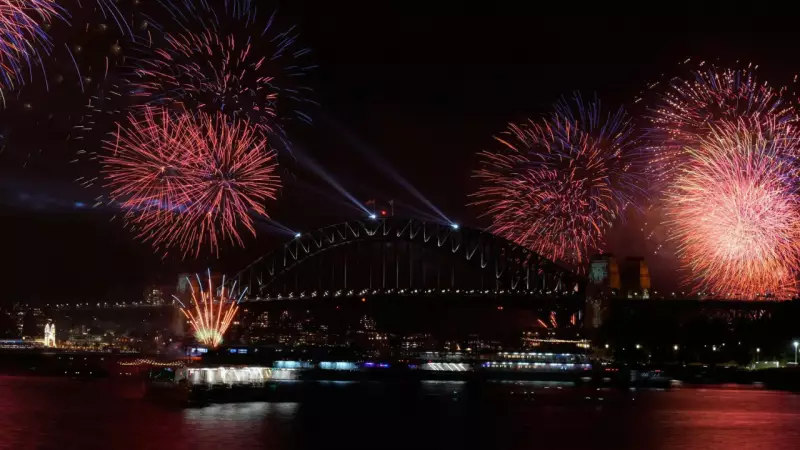
In Australia, Sydney's world-famous Harbour Bridge celebrations proceeded with a determined, "defiant" spirit. This comes in the wake of the tragic Bondi Beach mass shooting on December 14, which claimed 15 lives. Security was unprecedented, with police officers visibly carrying rapid-fire rifles among the crowds. The commemoration included a minute of silence an hour before midnight and the projection of a menorah on the bridge's pylons to honor the victims.

Subdued Observances in Asia and Massive Security in India
Several Asian nations opted for restrained festivities out of respect for recent tragedies. Indonesia significantly scaled back fireworks, with cities like Jakarta and Makassar holding prayer programs for the over 1,100 victims of catastrophic floods and landslides in Sumatra. Bali replaced its pyrotechnics with traditional cultural dance performances.
Similarly, Hong Kong cancelled its Victoria Harbour fireworks display following a deadly fire in November that killed 161 people. The city instead hosted a music show featuring the duo Air Supply and a three-minute light projection on eight landmark buildings at midnight.
In Japan and South Korea, traditional bell-tolling ceremonies continued in Tokyo and Seoul. Meanwhile, in India, security was the paramount focus for authorities managing massive gatherings. In Bengaluru, approximately 20,000 police personnel were deployed to oversee an expected crowd of ten lakh (one million) revelers. Karnataka Home Minister G Parameshwara outlined extensive measures including:
- Use of body-worn cameras and heat-map technology for real-time surveillance.
- Identification of 160 specific spots to monitor and curb drunken driving.
- Instructions for all bars to close by 1 AM.
- Establishment of fifteen "rest spots" for those unable to reach home safely.
In the national capital region, Delhi traffic police issued advisories for NH-44 near the Khatu Shyam Delhi Dham Mandir to manage the influx of devotees and New Year travelers.
European Celebrations and a Global Mood
As the New Year countdown moved westward, Berliners gathered in snowfall at the Brandenburg Gate for celebrations, even as fog obscured the city's famous TV Tower. The global mood, as evidenced from the Pacific to Europe, was distinctly bifurcated. While the spirit of renewal and hope inherent in a new year was palpable, it was equally tempered by recent acts of violence, natural disasters, and a heightened global focus on public safety and collective mourning.
The entry into 2026 thus stands as a testament to resilience—a global community choosing to mark time's passage with both celebratory sparks and quiet tribute, navigating joy and sorrow under the same sky.