Visva-Bharati Faculty Members Take Election Commission to Court Over Poll Duty Controversy
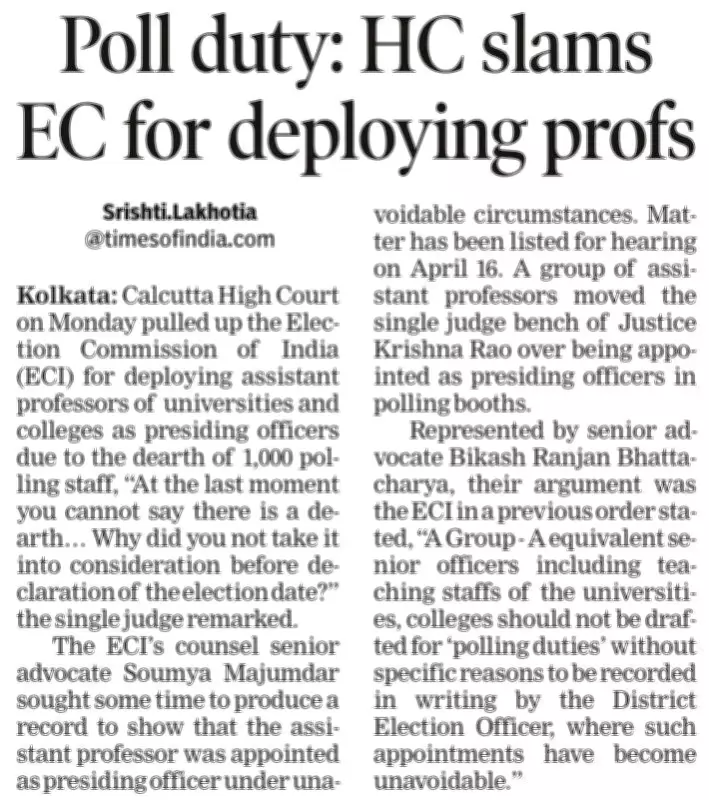
In a significant development following relief granted to Calcutta University assistant professors from presiding officer roles, multiple faculty members from Visva-Bharati University approached the Calcutta High Court on Monday. This legal action came after approximately 50 academics received show-cause notices from the Election Commission of India for failing to attend mandatory poll-related work training sessions.
Election Commission Also Approaches Court Challenging Previous Order
The Election Commission simultaneously approached a division bench of the Calcutta High Court on the same day, formally challenging an order issued by Justice Krishna Rao. This previous judicial decision had quashed the deployment order requiring assistant professors to serve as presiding officers at polling stations during elections.
A brief hearing took place before Justice Rao, where counsel representing the Visva-Bharati faculty members referenced the favorable order previously granted to Calcutta University professors. The Election Commission's legal representatives informed the court that they had officially challenged that very order earlier that Monday.

Legal Arguments and Judicial Proceedings
During the proceedings, it was argued that the Supreme Court has consistently maintained that high courts should refrain from entertaining petitions under Article 226 that question the election process once official notifications have been issued. To this point, senior advocate Bikash Ranjan Bhattacharyya interjected, stating clearly: "That's in a different context."
The Election Commission's counsel further submitted a notification from 2023 to support their position. Justice Rao responded pointedly to the EC's legal team: "I gave you three opportunities and now you are bringing this?"
Faculty Members' Grievances and Redesignation Issues
According to detailed submissions from the Visva-Bharati faculty members, 104 of them were originally appointed as micro-observers through an order dated March 19. These academics attended their initial phase of training for these supervisory roles. However, through a subsequent notice issued on April 11, they were "abruptly" redesignated as presiding officers without prior notice or opportunity for hearing.
The faculty members' petition claims that "the redesignation mechanically covers the entire academic hierarchy, demonstrating total absence of rank-sensitive consideration." They argue that after initially being deemed suitable for supervisory, confidence-based micro-observer duties through the March 19 order, the Election Commission could not have downgraded all 104 petitioners en masse to polling station operational assignments as presiding officers without disclosing fresh material justifying such a significant change.
The petition further states: "Such self-contradictory administrative conduct amounts to approbation and reprobation in the same election process, and independently demonstrates manifest non-application of mind." After the faculty members refused to assume presiding officer roles, show-cause notices were formally served to them on April 17.
Academic Concerns About Training and Preparation
One professor involved in the case explained the practical difficulties: "I received training specifically for micro-observer duty but suddenly I was assigned presiding officer duty. It is genuinely difficult to suddenly switch from micro-observer to presiding officer duty without completing two rounds of proper training. The entire situation suggests there was no proper planning or consideration for our professional responsibilities and preparation requirements."
The case highlights ongoing tensions between academic institutions and election authorities regarding the appropriate deployment of educational professionals during electoral processes, with significant implications for both election administration and academic functioning.