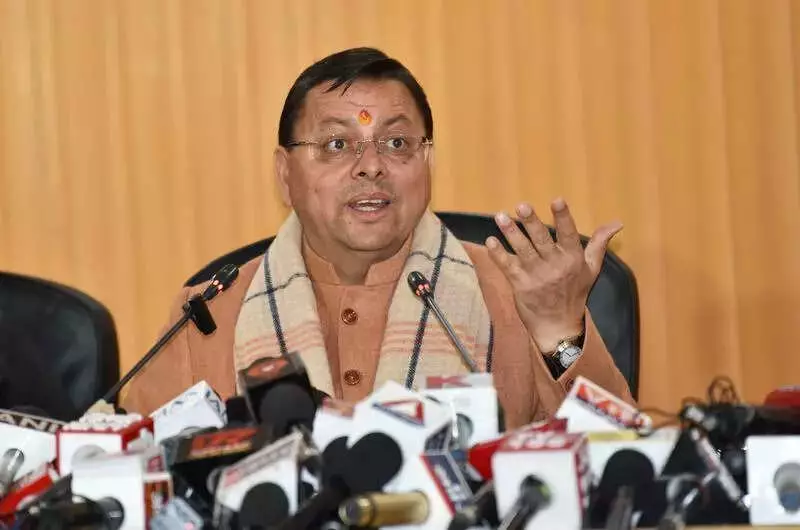
Dehradun: Marking the first anniversary of the Uniform Civil Code (UCC) implementation in Uttarakhand, Chief Minister Pushkar Singh Dhami announced on Tuesday that no instances of halala or iddat have been reported across the state over the past twelve months. Speaking at an event held at the Himalayan Cultural Centre to commemorate this milestone, Dhami emphasized that the UCC has ushered in a new era of gender equality and social justice.
Empowering Women and Ensuring Safety
Dhami highlighted that the live-in registration provision within the UCC was made compulsory with the primary objective of safeguarding women's security and providing them with robust legal protection in today's evolving social landscape. He stated, "Due to the existence of diverse personal laws, discrimination, inequality, and injustice were rampant. With the introduction of the Uniform Civil Code, equal rights have been firmly established, initiating a transformative chapter in women's empowerment."
The Chief Minister further elaborated that Muslim women in Uttarakhand are now liberated from oppressive practices such as halala, iddat, polygamy, child marriage, and triple talaq. He noted that these women have warmly welcomed the legislation, and since its enforcement, there have been no reported cases of halala or polygamy, underscoring the law's positive impact.
Constitutional Foundation and Social Harmony
Referencing Article 44 of the Indian Constitution, Dhami remarked, "Dr. B.R. Ambedkar and the framers of our Constitution incorporated the Uniform Civil Code into the Directive Principles of State Policy. They envisioned a single, common law applicable to all citizens, fostering unity and fairness." He clarified that the UCC is not targeted against any specific religion or community but represents a progressive legal measure designed to eradicate social evils and promote equality and harmony within society.
Surge in Marriage Registrations
Official statistics reveal a significant increase in marriage registrations following the UCC's implementation. Previously, the state recorded an average of 67 marriages per day, but this number has skyrocketed to over 1,400 daily registrations. In the past year alone, more than five lakh applications have been submitted, with over 95% of them successfully processed and resolved.
State officials attribute this remarkable efficiency to the user-friendly online portal system and the extensive network of 7,500 active Common Service Centres, which have significantly enhanced accessibility and streamlined the registration process for citizens across Uttarakhand.
Low Participation in Live-In Registration
Despite the government's assurances of privacy and legal protection, data on live-in relationship registrations indicates minimal participation. According to the UCC portal, only 70 couples have formally registered their live-in arrangements, with two of these relationships subsequently being terminated. Many couples have expressed reluctance and hesitation, citing concerns over privacy and the intrusive nature of the registration process.
Legal experts and citizens interviewed by TOI remain apprehensive about the law's practical implementation and its potential implications for personal privacy, consent, and real-life circumstances. A couple from Dehradun, communicating through their advocate, described the procedure as "intrusive," while lawyers reported that numerous young couples find the process challenging and worry about maintaining anonymity.
Legal Challenges and Public Concerns
One couple has filed a petition in the high court, questioning the legality of mandating parental consent for individuals above the age of 16 when the legal age for marriage is 18. This case is scheduled for hearing at the end of February, highlighting ongoing debates surrounding the UCC's provisions.
Abhijay Negi, a prominent advocate for personal liberty, observed, "Even educated individuals are encountering difficulties with the registration process. There are legitimate fears that this could turn into a witch hunt, targeting couples in live-in relationships."
Former Uttarakhand Bar Council chairperson Razia Baig added, "If people are genuinely willing to register, what obstacles are preventing them? Assurances of anonymity may be concealing the actual situation. The reality is that the Uniform Civil Code instills fear in many couples who are cohabiting, deterring them from formalizing their relationships under this law."