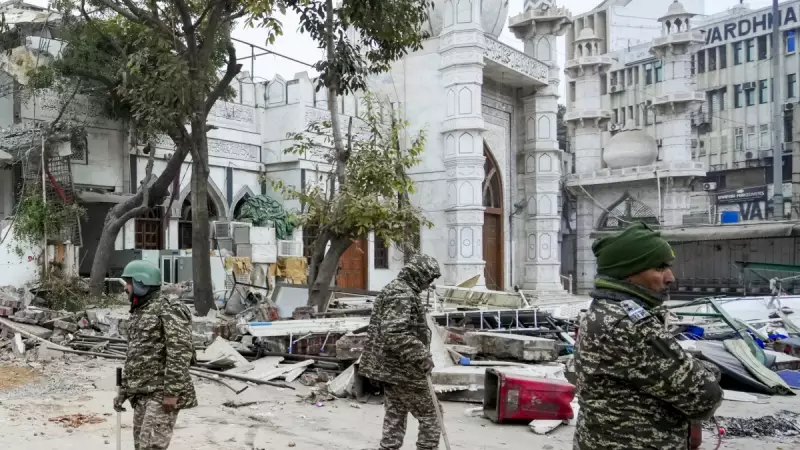
The Turkman Gate area in central Delhi witnessed significant tension and clashes following a demolition drive carried out by civic authorities. The events unfolded over several hours, marked by a heavy police presence, protests from local residents, and eventual violence. This incident has brought the issue of urban development and displacement in densely populated historical areas of the national capital back into sharp focus.
Chronology of the Turkman Gate Demolition Drive
The operation began in the early hours of the morning. Authorities from the Municipal Corporation of Delhi (MCD), accompanied by a substantial police force, arrived at the Turkman Gate locality. The official reason cited for the action was the removal of illegal encroachments and unauthorized structures that were allegedly causing obstruction and violating municipal norms.
Residents, however, were caught by surprise and strongly opposed the move. They argued that they had been living in the area for decades and that the structures were not illegal. As bulldozers moved in, a crowd began to gather, leading to a standoff between the police and the local populace.
Escalation into Clashes and Stone Pelting
The situation escalated rapidly from a protest to a full-blown confrontation. As the demolition machinery proceeded, sections of the crowd started raising slogans and attempting to physically block the officials and the bulldozers. The police, deployed in large numbers to maintain law and order, attempted to disperse the crowd.
This led to heated arguments and pushing between the two sides. Witnesses reported that the tension reached a boiling point when some individuals in the crowd began pelting stones at the police personnel and officials on the site. The police responded with measures to control the mob, which included the use of tear gas shells and mild lathi-charge in certain pockets to bring the situation under control.
The stone-pelting and police response created a chaotic scene, causing injuries to several people from both sides. A number of protesters and a few police personnel sustained injuries during the clashes. The sound of stones hitting vehicles and the shouts filled the air, turning the historic gateway area into a zone of conflict for several hours.
Aftermath and Political Reactions
Following the intense clashes, the demolition drive was temporarily halted. The area was heavily cordoned off by police forces to prevent any further gathering or violence. Senior police officials and civic authorities were present at the spot to assess the situation and decide on the future course of action.
The incident triggered immediate political reactions. Local leaders and representatives from various political parties visited the site. The ruling party at the civic body defended the action as a necessary step for urban planning and safety. Meanwhile, opposition parties and local community leaders condemned the drive, calling it high-handed and insensitive towards the poor and middle-class residents who would be rendered homeless.
The event at Turkman Gate is not an isolated one but part of a larger pattern of demolition drives in Delhi that often lead to legal battles and public outcry. It raises critical questions about the process of executing such drives, the rehabilitation of affected people, and the balance between urban development and the rights of existing residents.
The Delhi Police have registered cases in connection with the violence and stone-pelting, and investigations are ongoing. The future of the demolished structures and the residents remains uncertain, with talks of potential legal challenges against the civic body's action.