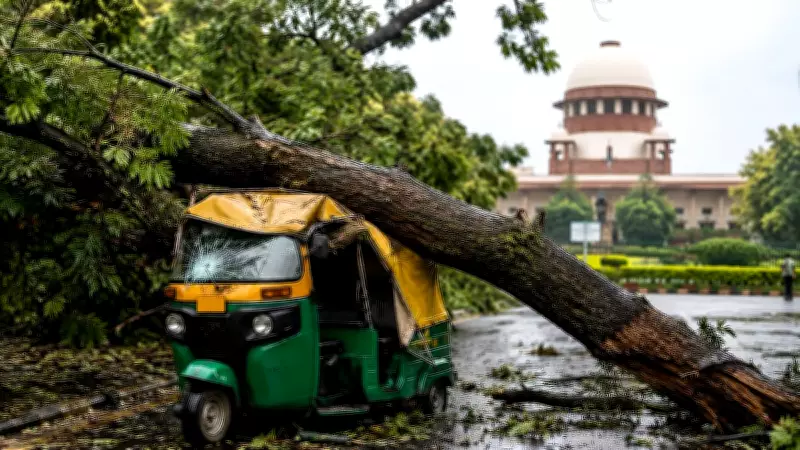
The Supreme Court has ruled that a tree falling on an autorickshaw does not qualify as a 'motor accident' under the Motor Vehicles Act, but still awarded Rs 25 lakh in compensation to an injured passenger. The judgment came as a relief to the victim, whose claim for Rs 50 lakh was earlier dismissed by the Motor Accident Claims Tribunal in Bengaluru, which termed the incident a natural calamity.
Case Background
The incident occurred when a tree suddenly fell on an autorickshaw, causing severe injuries to the passenger. The victim filed a claim petition seeking Rs 50 lakh compensation under the Motor Vehicles Act. However, the tribunal rejected the claim, stating that the incident was a natural calamity and not a motor accident as defined under the Act.
Supreme Court's Ruling
On appeal, the Supreme Court examined the definition of 'motor accident' under the Motor Vehicles Act. The bench observed that the term 'motor accident' typically involves the use of a motor vehicle as a vehicle, such as collisions, overturns, or other incidents arising from its operation. In this case, the tree fall was an independent event not caused by the vehicle's movement or use.

Despite this, the Court emphasized the principle of social justice and the need to compensate victims of road accidents. It noted that the passenger was an innocent victim and that the vehicle was being used as a mode of transport at the time of the incident. The Court invoked its extraordinary powers under Article 142 of the Constitution to award compensation, ensuring that the victim receives adequate relief.
Compensation Awarded
The Supreme Court directed the insurance company to pay Rs 25 lakh to the injured passenger, along with interest at 9% per annum from the date of filing the claim petition. The Court also observed that the tribunal's classification of the incident as a natural calamity was too narrow and failed to consider the broader context of the victim's suffering.
Legal Implications
The judgment clarifies the scope of 'motor accident' under the Motor Vehicles Act, but also highlights the Court's willingness to go beyond strict legal definitions to deliver justice. Legal experts believe this ruling could set a precedent for similar cases where accidents involve external factors not directly linked to vehicle operation.
The decision has been welcomed by consumer rights groups, who argue that victims should not be denied compensation due to technicalities. The insurance sector is expected to review its policies in light of this judgment.