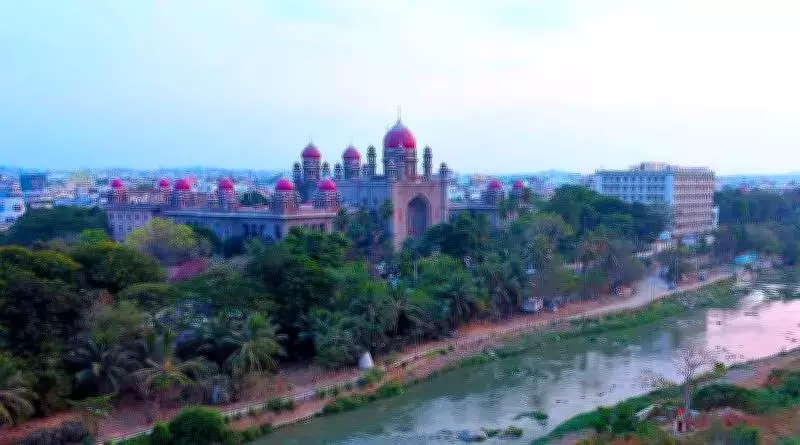
Telangana High Court Directs Authorities on Hyderabad Metro Phase-II Heritage Concerns
The Telangana High Court issued significant directives on Wednesday, compelling the state government and the Hyderabad Airport Metro Limited (HAML) to submit a detailed affidavit. This affidavit must outline the current status of applications seeking construction permission for the highly anticipated Phase-II of the Hyderabad Metro rail project. The court's order places particular emphasis on the project's interaction with heritage structures and their surrounding precincts along the proposed seven-kilometre alignment.
Focus on Heritage Preservation and Committee Functionality
The division bench, led by Chief Justice Aparesh Kumar Singh and including Justice GM Mohiuddin, mandated that the authorities provide comprehensive details. These details must cover the stage of any construction activity that could potentially impact heritage sites. Furthermore, the court explicitly asked for clarification on whether the conservation committee, established under the Telangana Heritage (Protection, Preservation, Conservation and Maintenance) Act of 2017, has been properly constituted and is fully operational. The hearing for this matter has been adjourned and is scheduled to resume on March 3, 2026.
These judicial instructions followed a thorough review of a PowerPoint presentation submitted in compliance with a prior court order. The presentation, which focused on the proposed Metro alignment, asserted that the project would not adversely affect any structures protected under the 2017 Heritage Act. This claim directly countered allegations raised in a public interest litigation (PIL) and a connected writ petition challenging the project's execution.
Government's Stance on Heritage Structures Along the Route
During the court proceedings, Additional Advocate General Mohd Imran Khan presented the government's position. He informed the bench that a total of 102 structures, including various temples, mosques, chillas, dargahs, and graves—some of which are unnamed—are situated either below or in close proximity to the proposed Metro alignment. Khan assured the court that all these structures would remain completely untouched by the construction of the new track.
He further stated that only three older structures would be affected by the project:
- An old GHMC building located opposite Aza Khana Zohra
- The historic clock tower at Raja Rai Devdi (also known as the Shyamraj Building)
- The Aliyabad Sarai
Khan argued that these three structures are currently in a dilapidated condition and have suffered significant damage due to rain over time. Regarding the clock tower at Raja Rai Devdi, where a Metro station is proposed, he mentioned that initial efforts were made to integrate the tower into the station's architectural design. However, this integration proved unfeasible due to the structure's present poor state of preservation.
Legal Challenges and Counterarguments from Petitioners
Opposing the government's submissions, Immaneni Rama Rao, the counsel representing the PIL, raised serious objections. He contended that excavation and other preliminary construction works had already commenced without obtaining the mandatory approvals from the conservation committee. Rao alleged that these activities began even before the committee itself had been formally constituted, violating procedural norms.
He further argued that, despite previous High Court rulings which explicitly state that heritage structures cannot be reconstructed or recreated, construction works were nevertheless undertaken at these sensitive heritage sites. Rao specifically disputed the claim that the old GHMC building was dilapidated, asserting that the damage observed was actually caused by the government's own demolition of a neighbouring structure. He added that several other heritage structures along the route remain vulnerable to potential damage due to the Metro project's activities.
In a separate writ petition, counsel Syed Yousuf brought additional concerns to the court's attention. He submitted that the Aliyabad Sarai is a 300-year-old property officially notified as a wakf (Islamic endowment) property. Yousuf argued that it is being incorrectly treated as private property for acquisition purposes. He claimed that the consent obtained from alleged owners and tenants is based on disputed ownership, raising further legal and ethical questions about the acquisition process.
The court's directive underscores the critical balance between urban infrastructure development and the imperative to preserve cultural and historical heritage. The affidavit ordered from the state government and HAML is expected to provide much-needed clarity on these complex issues, ensuring that the Hyderabad Metro Phase-II project proceeds with due regard for legal compliance and heritage conservation.