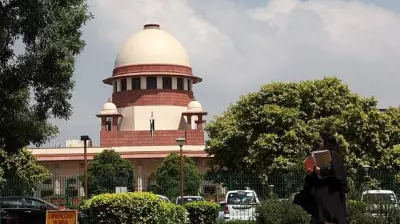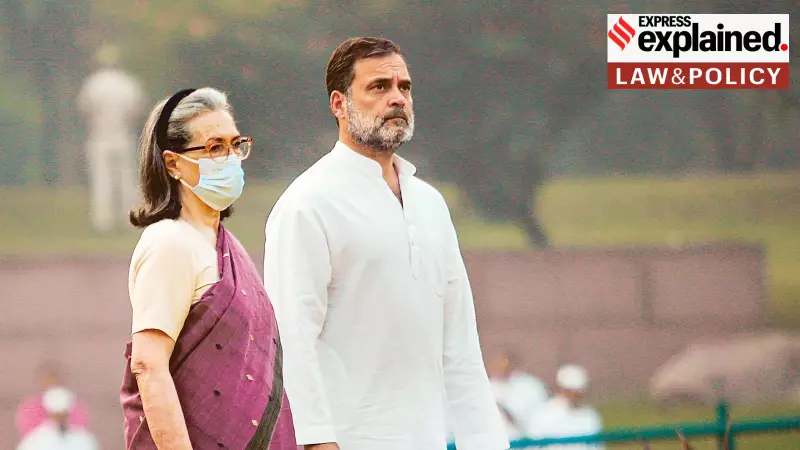
In a significant legal development, a special court in Delhi has refused to initiate proceedings on a high-profile money laundering case filed by the Enforcement Directorate (ED) against senior Congress leaders Sonia Gandhi and Rahul Gandhi, along with five other individuals. The case pertained to the alleged illegal acquisition of assets worth Rs 2,000 crore belonging to the National Herald newspaper's publisher.
The Core of the Allegations and the Court's Decision
Special Judge Vishal Gogne of the Rouse Avenue Court delivered a 117-page order on Tuesday, December 18, 2025, declining to take cognizance of the ED's prosecution complaint. This decision effectively halts judicial proceedings based on the agency's current filing. The ED's primary claim was that the Gandhis, along with other Congress office-bearers, conspired to take over the assets of Associated Journals Limited (AJL), the publisher of the National Herald.
The financial sequence alleged by the probe agency involved a loan of Rs 90.21 crore extended by the All India Congress Committee (AICC) to AJL. Later, Young Indian, a not-for-profit company where Sonia and Rahul Gandhi collectively held a 76% stake, purchased the right to recover this loan from the AICC for a sum of Rs 50 lakh. The ED contended that AJL then converted the outstanding loan into 9.02 crore equity shares, valued at Rs 10 each, in favour of Young Indian. This maneuver, according to the agency, defrauded both AJL's shareholders and the AICC's public donors.

Two Key Legal Grounds for Dismissal
The court's rejection was anchored on two fundamental legal principles under the Prevention of Money Laundering Act (PMLA).
Firstly, the issue of a private complaint. The ED's case was built upon a 2014 magistrate order that summoned the accused based on a complaint by BJP leader Subramanian Swamy. The special court clarified that the PMLA only allows complaints to be filed by an investigating officer from a law enforcement agency, not by private individuals. This rendered the foundational basis of the ED's action procedurally infirm.
Secondly, and more crucially, the absence of a predicate offence. Money laundering under the PMLA is defined as dealing with "proceeds of crime" derived from a "scheduled" or predicate offence listed in the Act's schedules. The court found that there was no First Information Report (FIR) registered against the accused for any such predicate offence. Despite the ED sending letters to the Central Bureau of Investigation (CBI) in 2014 and 2015 based on Swamy's complaint, the CBI never filed an FIR.
The order extensively referenced Supreme Court rulings and international standards to reiterate that "the registration of a FIR qua the scheduled offence was a sine qua non (an essential condition) for prosecution under the PMLA." This counters the ED's recent argument that money laundering can be investigated as a standalone offence.
Implications and Future Legal Pathways
This ruling is a major setback for the ED in this politically sensitive case. The PMLA offers agencies stringent powers, including tough bail conditions and the ability to attach properties. The court's insistence on a predicate offence reaffirms a critical legal safeguard.
Separately, the Income Tax Department has been investigating Young Indian since 2017 for alleged tax fraud. However, IT cases are not classified as scheduled offences under the PMLA. In a potentially related move, the Delhi Police Economic Offences Wing filed an FIR in November 2025 in the same matter. The complainant in this police case is Shiv Kumar Gupta, an Assistant Director of the ED, and the complaint relies on the 2014 summoning order. This could represent an attempt to establish a predicate offence, potentially opening a new avenue for a future money laundering probe.
The legal battle surrounding the National Herald and the assets of its publishing company continues, with this court order marking a pivotal chapter that underscores the procedural boundaries within which agencies must operate.