
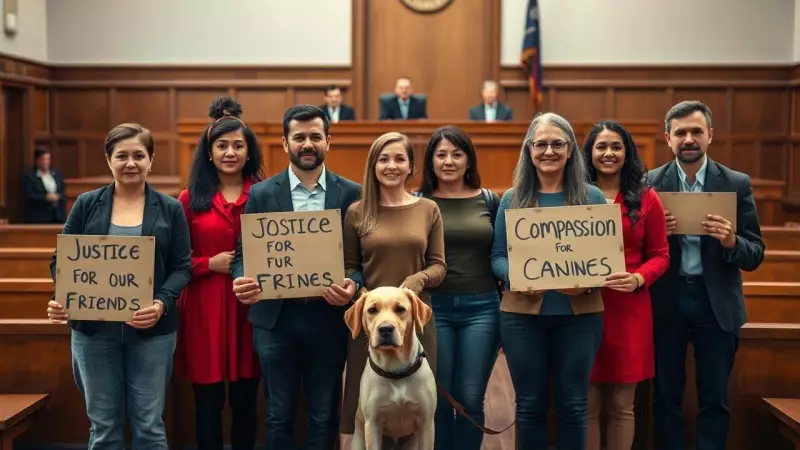
The Supreme Court of India's 2025 directives for the permanent relocation of community dogs to shelters have ignited significant controversy and public indignation, particularly among the nation's youth and animal welfare advocates. Chandigarh-based advocate Siddharth Arora, in a detailed critique, argues that the court's orders represent a stark departure from India's history of compassionate jurisprudence and violate established legal and scientific frameworks governing animal welfare.
The Controversial Orders and Public Backlash
The legal saga began when a bench of Justices Pardiwala and Mahadevan took suo moto cognizance based on a July 28, 2025, news report alleging 2000 daily dog bite cases in Delhi. On August 11, 2025, the court ordered local authorities in Delhi-NCR to round up all community dogs and relocate them permanently to shelters. This initial order triggered large-scale nationwide protests, leading then Chief Justice B.R. Gavai to constitute a three-judge bench.
Recognizing the harshness of its initial directions, the court modified its order on August 22, 2025. It ruled that all community dogs must be released back to their territories after sterilization, except for rabid or aggressive dogs. The scope was expanded to include all states, with calls for compliance reports on the Animal Birth Control (ABC) Rules 2023, and the designation of feeding spots was mandated.
However, on November 7, 2025, citing deficient ABC Rule compliance and media reports of rising bites, the court ordered the shifting of community dogs from five specific institutional areas—schools, sports stadiums, hospitals, bus stands, and railway stations—to designated shelters. Arora contends this final order, coupled with reported cruel capture methods by municipalities, created widespread angst and indignation.
Legal and Scientific Deficiencies of the Order
Arora's analysis asserts the November 7 order is erroneous on legal, scientific, and social counts. The legal framework rests on the Constitution, the Prevention of Cruelty to Animals (PCA) Act 1960, and the ABC Rules 2023.
Constitutional and Statutory Violations: He highlights Article 48-A (state duty to protect animals), Article 51-A(g) (citizen's duty of compassion), and the Supreme Court's own precedent in the AWBI v A Nagaraja case (2014), which extended Article 21's right to life to animals. The PCA Act establishes the Animal Welfare Board of India (AWBI) and criminalizes cruelty.
The core of the legal argument centers on the ABC Rules 2023, which are based on the WHO-endorsed Capture, Sterilize, Vaccinate, and Release (CSVR) model. Rule 11 explicitly bars the permanent relocation of community dogs, a provision grounded in canine territorial behavior and human welfare. Arora argues the Supreme Court's expulsion order directly violates this rule, marking a dark day in its jurisprudence.
Flawed Foundation: He criticizes the court for basing its intervention on an unverified media report by a trainee journalist. He points to systemic inflation of dog bite statistics in government hospitals—where monkey, rat, or pet dog bites are often misclassified, and each rabies vaccine dose is counted as a separate bite—potentially driven by corruption to secure more vaccine funding. He notes the court ignored India's 151st ranking in the 2025 World Press Freedom Index while relying on such reporting.
Procedural Lapse: A significant legal flaw cited is the violation of the principle of audi alteram partem (hear the other side). The court did not afford a hearing to animal defenders who had deposited INR 2,00,000 to be heard, resulting in a mockery of justice and scientific temper.
Social Realities and the Path Forward
Beyond legal arguments, Arora emphasizes social and practical failures of the order. He notes that community dogs provide security, companionship, and therapy, and India lacks the infrastructure and funding to house them permanently. Existing government shelters are often described as places of neglect and suffering.
The critique extends to media and political discourse. He accuses national media of running a months-long campaign of sensational, exaggerated reports on dog bites, fostering fear over reality. This, he suggests, serves as a distraction from pressing issues like inflation, unemployment, and corruption. He references a 2021 judgment by Justice J.R. Midha that traced the disparagement of Indian community dogs to colonial attitudes, lamenting that such discrimination persists.
The Way Forward is Coexistence: Arora unequivocally states that coexistence is the only constitutional and practical way forward. He calls for:
- Full implementation of ABC Rules 2023 by the state in letter and spirit.
- Developing a public-private partnership model involving compassionate citizens and animal welfare organizations.
- Media must stop slanted narratives, adhere to journalistic conduct norms, and report on animal cruelty cases.
- The Supreme Court must restore its credibility by reverting to compassionate jurisprudence and modifying its November 7 order to align with the law, releasing dogs picked up from institutional areas.
- Educational institutions and parents must inculcate compassion and scientific understanding of human-animal interaction in children.
He concludes with a powerful appeal: "In a country which shuns compassion, progress can never take place and Viksit Bharat 2047 will remain illusory forever." Citizens must choose compassion, knowledge, and scientific temper over hatred, fear, and propaganda.