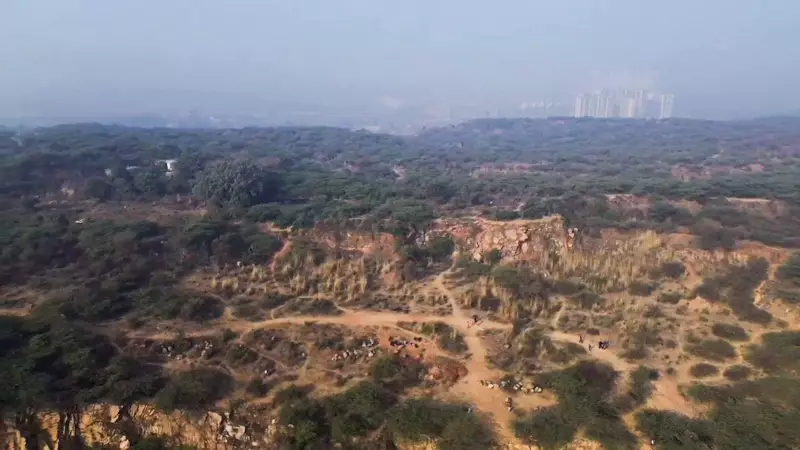
In a significant move, the Supreme Court of India has put on hold a contentious report by an Environment Ministry-led committee that recommended defining the Aravalli hills based on a 100-metre height criterion. The apex court's order, dated December 30, 2025, also stays its own November 20 judgement that had initially accepted the committee's report, paving the way for a more comprehensive and participatory review of the ecologically fragile range.
Court Recognizes Multiple Threats, Calls for Domain Experts
The Supreme Court's order is notable for broadening the scope of threats to the Aravallis beyond just mining. It explicitly records that "decades of unchecked urbanization" and "systematic deforestation" – alongside intensive resource extraction – have placed immense strain on the ecosystem. To address this, the court has proposed constituting a High-Powered Expert Committee (HPEC).
Crucially, the order emphasizes that the HPEC must comprise "domain experts" to ensure a fair and impartial opinion, seen as a directive against forming a committee dominated solely by bureaucrats. The court stressed the need for "associating all requisite stakeholders" to achieve informed decision-making.

Addressing Core Public Concerns: Lower Hills and Wide Gaps
The court's order directly tackles the widespread public dissent and criticism stemming from the perceived ambiguity of the 100-metre definition. It identifies two primary concerns that the new expert panel must examine in detail.
First, it addresses the exclusion of lower hills. The order specifically seeks confirmation on data, reportedly from an internal Forest Survey of India (FSI) analysis, that only 1,048 out of 12,081 Aravalli hills which are 20 metres or higher would qualify under the 100-metre definition. The HPEC is tasked with conducting an exhaustive scientific investigation to see if this creates a significant regulatory gap, potentially leading to the "eventual erasure or degradation" of excluded hills.
Second, the order questions the ecological logic of the 500-metre gap threshold in the definition. It asks the committee to analyse whether hills defined under the 100-metre rule would still form a "contiguous ecological formation" if the distance between them exceeds 500 metres. It raises the critical issue of whether excluding such intervening areas would create a "structural paradox", narrowing the protected territory and allowing unregulated mining in ecologically contiguous zones.
Pathway to Logical Finality and Conservation Hope
The Supreme Court's intervention ensures that no irreversible administrative or ecological actions are taken based on the current, contested framework. It reiterates that no mining permissions shall be granted without the court's nod in the Aravalli Hills and Ranges as defined in the FSI Report dated August 25, 2010 – a nod to the older three-degree-slope formula advocated by the FSI and the court's own advisors.
Environmental lawyer Ritwick Dutta viewed the order as an indication that the earlier committee report was "prepared in haste" and the government's public response was not convincing, prompting the court's suo motu review. Independent analyst Chetan Agarwal welcomed the move, stating it prevents the overturning of decades of Aravalli conservation jurisprudence. He expressed hope that the new committee would view the Aravallis as a living, breathing habitat crucial for wildlife, air pollution moderation, and groundwater recharge.
The three-judge vacation bench, headed by Chief Justice of India Justice Surya Kant, heard the matter on December 29. The composition of the proposed HPEC will now be crucial in determining the future of this ancient mountain range, as the Supreme Court seeks a "logical finality" grounded in robust science and inclusive stakeholder consultation.