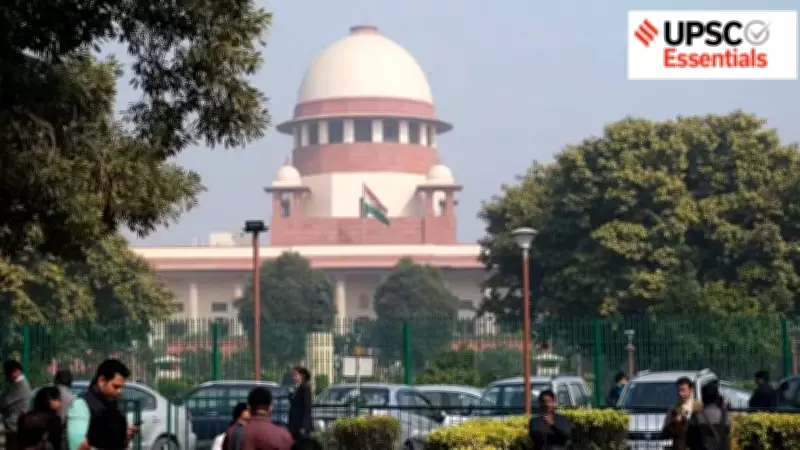
Why Supreme Court's Split Verdict on Corruption Law's Prior Approval Clause Ignites Rule of Law Debate
The Supreme Court of India last month delivered a significant split verdict on the constitutional validity of Section 17A of the Prevention of Corruption Act, 1988, reigniting crucial debates about governance, accountability, and legal principles. This provision mandates prior approval by competent authorities before investigating public servants for actions taken in their official capacity, creating a legal shield that has now divided judicial opinion at the highest level.
The Constitutional Challenge and Divergent Judicial Views
Section 17A, introduced through the Prevention of Corruption (Amendment) Act, 2018, specifically states that "no police officer shall conduct any enquiry or inquiry or investigation into any offence alleged to have been committed by a public servant under this Act, where the alleged offence is relatable to any recommendation made or decision taken by such public servant in discharge of his official functions or duties, without the previous approval" of appropriate government authorities. This requirement has become the center of a constitutional controversy that reached the Supreme Court.
Justice K V Viswanathan upheld the provision's validity, emphasizing the need to protect public servants from harassment through frivolous complaints. Quoting Sardar Vallabhbhai Patel's description of civil servants as the "Steel Frame of India," Justice Viswanathan argued that without adequate safeguards, public officials might develop a "play it safe syndrome" that could paralyze administrative decision-making. He suggested the condition that approval authority should be independent rather than governmental.
In stark contrast, Justice B V Nagarathna struck down Section 17A as unconstitutional, declaring it violative of Article 14 of the Constitution. She expressed serious concerns that the prior approval requirement could impede timely investigations into corruption and create opportunities for institutional collusion between corrupt officials and sanctioning authorities. Justice Nagarathna viewed the provision as a significant fetter on the rule of law itself.
Fundamental Questions About Rule of Law and Equality
The split verdict has prompted examination of foundational constitutional questions:
- Does administrative law inherently conflict with the rule of law principles?
- How can anti-corruption legislation maximize public servant accountability without causing policy paralysis?
- Does differential treatment of public servants through prior approval requirements violate equality before law?
Justice Nagarathna specifically noted that while Section 17A "extends protection to all classes of public servants in substance, it extends only to those public servants who take decisions and make recommendations in the discharge of their official duties." This selective protection prompted scrutiny under Article 14's equality provisions.
Historical and Comparative Legal Perspectives
The debate echoes historical discussions about administrative law's relationship with rule of law principles. British constitutional theorist A V Dicey, in his seminal work The Law of the Constitution (1885), criticized French administrative law for granting government officials special privileges unavailable to ordinary citizens. Dicey warned that discretionary powers not controlled by ordinary courts could facilitate arbitrariness.
French jurist Maurice Hauriou offered a different perspective, noting that different countries approach state servant liability differently: "There are countries where every effort is made to shelter the liability of the State behind the personal responsibility of its servant. There are other countries where every effort is made to cover the responsibility of the servant of the State behind the liability of the State itself."
Balancing Competing Governance Imperatives
The Union government defended Section 17A as necessary to balance administrative efficiency with accountability. They argued that frivolous complaints don't merely affect individual officers but can erode institutional trust and create decision-making inertia. The provision aims to prevent public servants from becoming excessively risk-averse due to fear of prosecution for bona fide errors.
However, critics counter that excessive protection might enable corruption by creating procedural hurdles for investigations. The Supreme Court's 2014 judgment in Subramanian Swamy v. CBI, which struck down Section 6A of the Delhi Special Police Establishment Act for granting immunity to high-ranking officials, serves as relevant precedent questioning such protective measures.
The Policy Paralysis Concern
Indian bureaucracy already exhibits what Justice Viswanathan described as a "play it safe syndrome," where officials avoid decisions involving discretion to protect their reputations. Without adequate protection from frivolous complaints, even honest officials might prioritize personal safety over timely decision-making, potentially fostering institutional status quoism, red tape, and administrative delays.
Public servants with greater responsibilities and discretionary powers face higher vulnerability to motivated complaints, arguably justifying proportionately higher procedural safeguards. However, as Justice Nagarathna emphasized, such safeguards must not become disproportionate protections that compromise rule of law principles.
Path Forward and Constitutional Implications
The split verdict has resulted in the matter being referred to a larger Supreme Court bench to be constituted by the Chief Justice of India. Beyond the immediate legal controversy, this case raises profound questions about democratic governance:
- How can India develop an anti-corruption framework that protects honest officials while ensuring corrupt ones remain within legal reach?
- What constitutes appropriate procedural safeguards that don't undermine equality before law?
- How can administrative efficiency be balanced with robust accountability mechanisms?
The Supreme Court's eventual ruling will significantly shape India's anti-corruption landscape and define the delicate balance between protecting public servants from harassment and ensuring they remain accountable under the rule of law. This constitutional moment invites reflection on how democratic societies can maintain both efficient governance and robust accountability systems without compromising fundamental legal principles.