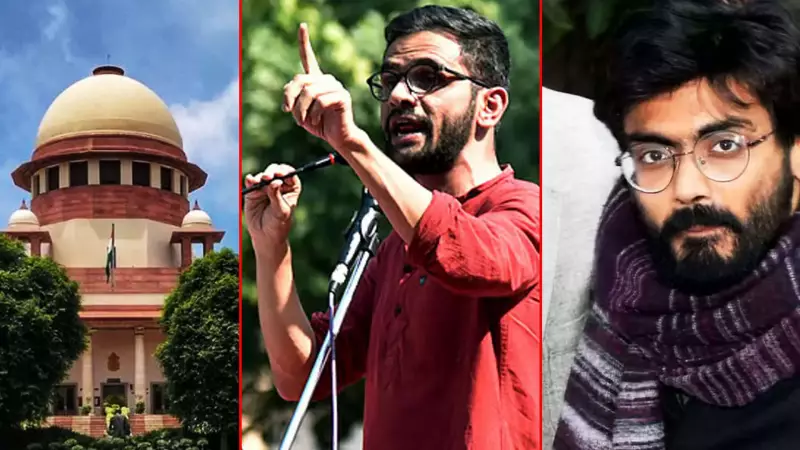
In a significant ruling, the Supreme Court of India delivered a split verdict on bail pleas in the high-profile 2020 Delhi riots larger conspiracy case. The apex court rejected bail for activists Umar Khalid and Sharjeel Imam but granted relief to five other accused who have been in custody for over five and a half years.
Court's Split Verdict on Bail Applications
A Bench comprising Justices Aravind Kumar and NV Anjaria pronounced the order on January 5, 2026. The court emphasized that each case must be evaluated on its own merits and factual matrix. While granting bail to Gulfisha Fatima, Meeran Haider, Shifa ur Rehman, Shadab Ahmed, and Mohammad Saleem Khan, the Bench took a stricter view against Khalid and Imam.
The judges noted that the allegations against Khalid and Imam stand on a "qualitatively different footing" based on prima facie evidence presented before the court. Both face serious charges under the stringent Unlawful Activities (Prevention) Act (UAPA) in connection with the larger conspiracy allegedly behind the communal violence that shook the national capital in February 2020.

Legal Grounds and Future Options for the Accused
The Supreme Court clarified that its decision to deny bail to the two high-profile accused is not absolute. The Bench stated that Umar Khalid and Sharjeel Imam can reapply for bail after one year or once the protected witnesses in the case are examined by the trial court. This provides a potential future legal avenue for the duo, whose bail pleas have been rejected by lower courts multiple times.
For the five who secured bail, the relief comes after an extensive period of incarceration. Their lawyer, Sarim Javed, welcomed the court's decision, highlighting the prolonged detention his clients had endured. The court's individual assessment approach meant that despite being part of the same broader case, their specific circumstances warranted a different outcome.
Reactions and Concerns Over Prolonged Detention
The verdict has sparked mixed reactions from legal experts and civil society. Former Union Law Minister Ashwani Kumar expressed concerns about the implications of extended pre-trial detention on personal liberty. He suggested that civil libertarians might view the Supreme Court's decision to keep Khalid and Imam in custody with disappointment, even as five others gained their freedom.
This case continues to be closely watched as it touches upon several critical legal questions, including the application of UAPA in conspiracy cases, the balance between national security concerns and individual rights, and the issue of prolonged incarceration without trial. The Delhi Police has accused the individuals of orchestrating the riots that resulted in over 50 deaths and widespread property damage.
The legal proceedings in the larger conspiracy case are expected to continue in the trial court, with the recent Supreme Court order setting important precedents for how bail applications are treated under anti-terror legislation in India.