

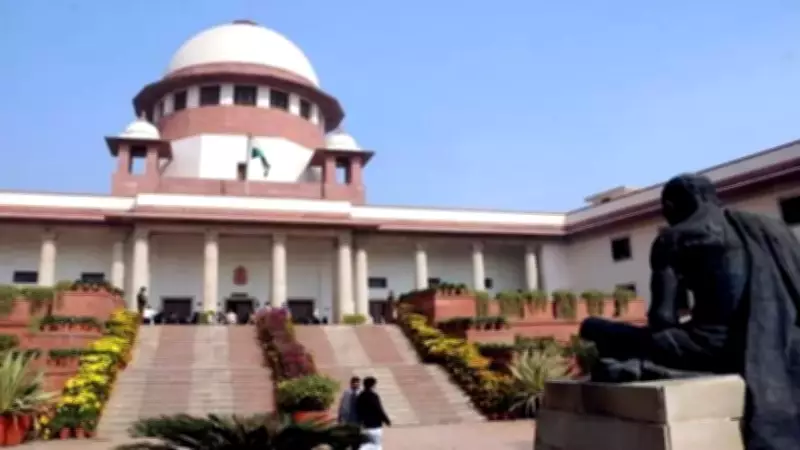
The Supreme Court on Wednesday declined to postpone hearings on petitions challenging the constitutional validity of the 2023 law concerning the appointment of election commissioners, emphasizing that the issue holds greater significance than any other pending matter.
A bench comprising Justices Dipankar Datta and Satish Chandra Sharma rejected a request from Solicitor General Tushar Mehta, who sought an adjournment due to his involvement in a nine-judge Constitution bench hearing cases related to religious freedom, including the Sabarimala Temple issue.
Justice Datta underscored the importance of the case, stating, “This matter is more important than any other matter.” He also commented on the prioritization of cases, noting, “We read in the newspapers that there is an observation that the PIL in Sabarimala should not have been entertained by the court. So, with due respect to the judges, nine judges are occupied in a matter where there is an observation that it should not have been entertained in the first place.”

The bench permitted the petitioners to begin their arguments and directed them to conclude submissions by Thursday, after which the Centre will be heard. The core issue revolves around the Chief Election Commissioner and Other Election Commissioners (Appointment, Conditions of Service and Term of Office) Act, 2023. This legislation altered the selection committee by removing the Chief Justice of India and replacing that position with a union minister nominated by the Prime Minister.
The challenge stems from a March 2023 Constitution bench ruling that mandated appointments to the Election Commission be made by a panel comprising the Prime Minister, the Leader of Opposition in the Lok Sabha, and the Chief Justice of India, an arrangement intended to remain until Parliament enacted a law.
Petitioners, including Congress leader Jaya Thakur and the Association for Democratic Reforms, argue that excluding the judiciary from the process undermines the Election Commission's independence. Earlier, Chief Justice Surya Kant recused himself from the case, citing a potential conflict of interest.
The Centre defends the law, asserting that the Election Commission's autonomy does not depend on a judicial member in the selection panel. It also refutes claims that the March 2024 appointment of two election commissioners was rushed to preempt judicial scrutiny, stating that the process adhered to the new law's provisions. The Supreme Court had previously declined to stay those appointments while agreeing to examine the broader constitutional challenge.
The adjournment request came amid ongoing proceedings before a nine-judge bench led by Chief Justice Surya Kant, which is revisiting religious freedom questions, including the Sabarimala issue. During Tuesday's hearing, the bench made strong observations about the 2006 PIL that led to the Sabarimala verdict, suggesting the court should have dismissed it as lacking proper locus standi and based on newspaper reports. The bench indicated that at most, a limited inquiry into alleged misconduct by temple authorities could have been ordered. Justice Nagarathna raised concerns about individuals not adhering to the faith questioning long-standing religious practices.






