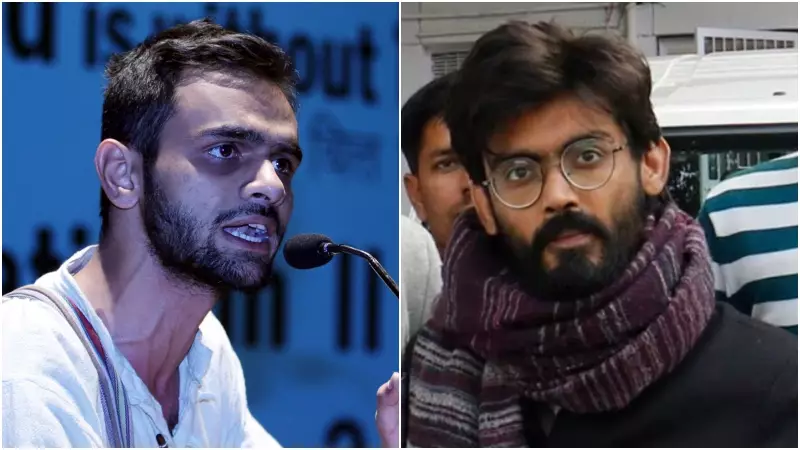
In a significant ruling that has sparked intense legal and political debate, the Supreme Court of India recently denied bail to activists Umar Khalid and Sharjeel Imam in the Delhi riots larger conspiracy case. The court's judgment, delivered on January 12, 2026, has drawn scrutiny for its reliance on a voluminous chargesheet that some legal experts argue is built on social prejudices and a top-down approach to establishing conspiracy. While granting bail to five other accused, the court's decision to keep Khalid and Imam in custody, coupled with its expansive interpretation of what constitutes a "terror act" under the Unlawful Activities (Prevention) Act (UAPA), has raised profound concerns about civil liberties and the application of anti-terror laws.
Deconstructing the Chargesheet: A Top-Down Narrative of Conspiracy
The core of the controversy lies in the chargesheet filed by the prosecution, which spans thousands of pages and annexes approximately 750 First Information Reports (FIRs) from police stations across Delhi. Critics, including Supreme Court advocate Shahrukh Alam, point out that the document fails to establish a clear, causal link between the alleged masterminds and the specific acts of violence that occurred in February 2020.
Instead of a bottom-up analysis connecting each incident and accused to the anti-Citizenship Amendment Act (CAA) protests, the chargesheet is accused of operating on a top-down premise: it starts with the assumption of a conspiracy and then fits events into this framework. Notably, the individual FIRs tell a more nuanced story, indicating that a majority of protest sites remained peaceful, some were attacked by external mobs, and clashes occurred at others. The chargesheet, however, does not adequately address critical questions such as the mobilization of groups supporting the CAA or whether accused individuals claimed provocation due to road blockades.
More critically, the legal analysis suggests the document leans on social and political prejudices, insinuating that Muslim political mobilization inherently harbors a "darker intent" beyond the stated grievance—in this case, opposition to the CAA. The evidence presented largely showcases public planning of protests and impassioned opposition to the law, but nothing concretely proving the movement was merely a ploy to overthrow the government, as alleged.
Judicial Scrutiny: Delay, Definition, and Unanswered Questions
The Supreme Court's bail judgment undertook a promised judicial scrutiny but arrived at conclusions that have worried legal observers. On the issue of prolonged incarceration without trial—a key bail consideration—the court held that UAPA offences involve state security concerns, thus courts cannot mechanically grant bail simply because the accused have suffered long pre-trial detention. This reasoning, critics argue, inadvertently frees prosecuting agencies from any urgency in concluding trials efficiently.
Perhaps the most far-reaching aspect of the order is its expansion of the definition of "terror offences." The judgment stated that the means employed for such acts are not restricted to explosives or firearms but may include "any means." Furthermore, the act's aim may not solely be violent destruction but could encompass effects like the disruption of essential services. This odd formulation appears to support the prosecution's case, even though the chargesheet does not allege any wholesale disruption of supplies or services. This broad reading risks bringing any disruptive protest, including civic action, under the terrifying umbrella of "terrorism," blurring the well-established legal distinctions between law and order issues, public disorder, and national security threats.
The Central Paradox: What Was Masterminded?
Despite upholding the central role ascribed to Umar Khalid and Sharjeel Imam by the prosecution, the judgment sidesteps a fundamental question: What exactly did they mastermind? The narrative suggests their conspiracy of political mobilization led to counter-mobilizations, which then resulted in street violence. However, as pointed out in the critique, this logic seems overly reliant on third-party actors unless they were all part of the same plan—an allegation not substantiated.
The bail conditions imposed on those released further reflect a chilling effect on dissent. One condition stipulates that the accused must not circulate any material, which could broadly be interpreted to include political humour or poetry critical of authority. This move, while aimed at preventing further alleged offences, is seen as discouraging not just civic action but also creative expression.
The January 12, 2026, ruling thus stands at a complex crossroads. It reinforces the state's powerful toolkit under the UAPA but does so by endorsing a chargesheet many find conceptually flawed and by expanding legal definitions in a manner that could have long-term implications for the right to protest and the very understanding of terrorism in Indian jurisprudence.